Guide · Start here

Types of Cigars: Every Shape, Size, and Category Explained (With a Shapes Chart)

Updated 2026-11-01Picks link to real lines in the catalog

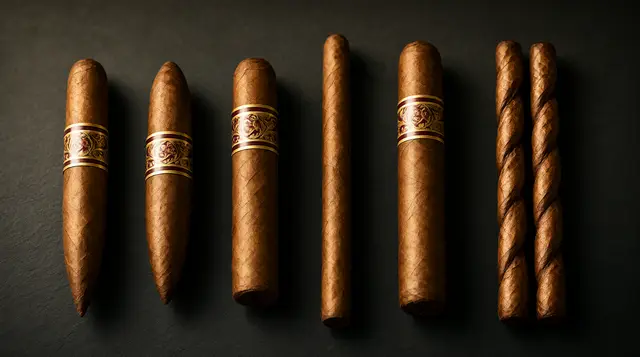
There are seven main ways to sort types of cigars: by shape, by size, by wrapper color, by strength, by country, by how they are built (long filler or short filler, handmade or machine-made), and by format (premium cigar, cigarillo, little cigar, flavored). When most people ask about cigar types they mean shape, and shape comes down to two families: parejos, the straight-sided cigars that fill most shelves, and figurados, the shaped ones like the torpedo, belicoso, perfecto, and culebra.

Most pages on this topic either dump forty vitola names on you with no sense of which matter, or blend shape, size, and color into one muddled list. This page is the map. Each category gets a short, plain explanation and a pointer to the guide that covers it in depth, and the part nobody explains well, the shaped cigars, gets a proper chart: what each one looks like, why it exists, and how it actually smokes.

I also cover the classification most guides skip: what legally counts as a premium cigar in the United States as of 2026, and where cigarillos, little cigars, and flavored cigars fit.

From the catalog

The picks

Cigars worth your time, with the specs straight from the catalog. Open any one to see its full sheet and what members have logged.

Medium · Dominican Republic · Cameroon wrapper · $10-$15

3.7from 5 member reviews

The line to learn the perfecto on. The catalog lists it as medium, Dominican, with a Cameroon wrapper, in the ten-to-fifteen dollar range. The Hemingway line is best known for its perfecto shapes, and the catalog's sizes run from the little Short Story at 4 inches by a 49 ring to the Masterpiece at 9 by 52. Light a Short Story and watch the flavor open up as the narrow foot burns into the wider body.

See specs & vitolas →

Medium-Full · Cuba · Habano wrapper · $20-$30

A long-standing reference for the pirámide. The catalog has it as medium-full, Cuban, with a Habano wrapper, at 6.1 inches by a 52 ring, in the twenty-to-thirty dollar range. It shows exactly what the shape is for: a wide body tapering to a point that focuses the smoke. It is Cuban, so whether you can buy it depends on where you live.

See specs & vitolas →

Full · Dominican Republic · Habano wrapper · $10-$15

The chisel, in its home line. The catalog lists it as full, Dominican, with a Habano wrapper, in the ten-to-fifteen dollar range, with a Chisel at 6 inches by a 54 ring. The flattened wedge head is La Flor Dominicana's own trademarked shape, and it is worth trying once just to feel it. Mind the strength: this one is full.

See specs & vitolas →

Medium · Nicaragua · Ecuador Habano wrapper · $10-$15

An approachable way into the salomon. The catalog has it as medium, Nicaraguan, with an Ecuador Habano wrapper, in the ten-to-fifteen dollar range, and its sizes include a Salomon at 7.625 inches by a 58 ring. Salomons are usually limited or pricey showpieces, so a medium-strength one at this price is a sensible first. Clear your evening.

See specs & vitolas →

Full · Cuba · Habano wrapper · $10-$15

The classic Cuban culebra. The catalog lists it as full, Cuban, with a Habano wrapper, in the ten-to-fifteen dollar range, with each of the three braided cigars at 5.75 inches by a 39 ring. Untie the string and smoke them one at a time, ideally with friends. Like any Cuban, availability depends on where you live.

See specs & vitolas →

Medium · Nicaragua · Habano wrapper · $10-$15

An easy way to try a box press. The catalog has it as medium, Nicaraguan, with a Habano wrapper, in the ten-to-fifteen dollar range, in a toro at 6 inches by a 52 ring and a corona at 5.5 by 48. Smoke it next to a round toro and decide for yourself whether the pressed shape changes anything for you.

See specs & vitolas →

How I picked these

The shapes chart reflects how makers and retailers use these names today, which is not always consistent, and I say so where the names overlap. The counts of which shapes are most common come from the vitola entries in the Cigarista catalog. The premium cigar definition comes from the April 2026 federal court order that re-adopted it. The cigars at the end are real catalog lines picked because each shows off one shape clearly, not ranked, and their specs come from the catalog.

The seven ways cigars are categorized

The first thing that clears up most confusion: these categories are independent. Every cigar sits in all of them at once. A single cigar can be a Nicaraguan, full-strength, maduro-wrapped, box-pressed toro, made by hand with long filler, and every one of those words answers a different question.

That is why so much cigar folk wisdom goes wrong. People mix the axes together and assume a darker wrapper means a stronger cigar, or a fatter cigar means more nicotine, or a pointed cigar means a fancier one. None of those follow. Shape and size change how the smoke is delivered and how long it lasts. Wrapper changes flavor. The filler blend is what decides strength.

The chart below is the whole map on one screen. Shape, construction, and format are covered in full on this page. The others get a short summary here and have their own deep guides, linked at the bottom.

Every common way to classify a cigar. A single cigar belongs to one type in every row.
CategoryThe main typesWhat it tells youWhere to go deeper
ShapeParejo (straight) and figurado (torpedo, belicoso, pyramid, perfecto, salomon, culebra, chisel)How it looks and how the draw and flavor buildThe shapes chart on this page
SizeNamed vitolas: lancero, corona, robusto, toro, churchill, gordo, and moreHow long it smokes and how cool it burnsCigar sizes chart
Wrapper colorCandela, claro, colorado, natural, maduro, oscuroFlavor and sweetness tendencies, not strengthCigar wrapper types
StrengthMild, medium, full, and the steps betweenHow hard the nicotine hitsCigar strength chart
CountryCuba, Nicaragua, Dominican Republic, Honduras, and othersThe broad house style of the tobaccoCuban vs Nicaraguan vs Dominican
ConstructionLong, short, or mixed filler; handmade or machine-madeBurn quality, price, and whether it is a premium cigarThis page
FormatPremium cigar, cigarillo, little cigar, flavored or infusedWhat kind of product it is in the first placeThis page, and cigar vs cigarette

Cigar shapes explained: parejo vs figurado

Every cigar shape falls into one of two families.

A parejo is a straight cylinder: even sides, a rounded cap at the head you cut, and an open foot you light. It is the default, the easiest shape to roll, store, and cut, and it is most of what you will ever see in a shop. In the Cigarista catalog, the two most-listed sizes are the toro and the robusto, both parejos, and they are far ahead of any shaped cigar. The most common figurado, the torpedo, shows up roughly a third as often as the toro.

A figurado is anything that is not a straight cylinder: a head tapered to a point, a foot pinched closed, a bulge in the middle, or several of those at once. Figurados take more skill to roll, because the roller has to shape the bunch and stretch the wrapper over curves, which is part of why fewer rollers make them and why they often cost a little more than the same blend in a parejo.

The important thing shape does not do is change strength. A torpedo and a robusto of the same blend have the same tobacco in them. What shape changes is delivery: where the smoke concentrates, how the draw feels, and how the flavor shifts as the cigar burns into wider or narrower sections.

A box-pressed cigar is the one shape that blurs the line. It is a parejo that has been squared off, either by being packed tightly into a box or deliberately pressed in a mold. Most people file it under parejo variants, which is where I put it in the chart.

Cigar shapes chart: torpedo, belicoso, pyramid, perfecto, and the rest

Here is every shape you are likely to meet, with the honest version of why each one exists. One warning before the chart: the names are not standardized. One maker's torpedo is another's pyramid, and belicoso covers everything from a short rounded taper to something nearly as pointed as a torpedo. Look at the cigar, not the word on the band.

A few things that sound like shapes are really finishing touches. A pigtail or fantail cap is a twist of wrapper leaf at the head, a closed foot is a foot finished with wrapper so it lights at a point, and a shaggy foot leaves the filler sticking out uncovered for a raw first few puffs. Any of these can turn up on a parejo or a figurado.

Cutting a pointed head is the one practical skill shaped cigars ask of you. Cut too little and the draw is tight, cut too much and the head can unravel. The cutting guide covers it, but the short version is to start small and cut more if you need it.

Common cigar shapes. Names vary between makers, so treat these as the usual meaning, not a rulebook.
ShapeWhat it looks likeWhy it existsHow it smokes
ParejoStraight sides, rounded cap, open footThe default: easiest to roll, store, and cutEven and predictable; the blend builds steadily
Box-pressedA parejo with flattened, squarish sidesPacked tight in boxes or pressed on purpose; sits flat and is easy to holdMany smokers find it burns a touch slower; it feels different between the lips
TorpedoStraight body with the head tapered to a pointThe point focuses smoke and lets you tune the draw with your cutCut a little for a focused draw, more for an open one
BelicosoA shorter, rounder taper at the headA gentler version of the pointed headLike a torpedo, a little easier to cut cleanly
Pyramid (pirámide)Tapers steadily from a wide foot to a pointed headA wide foot for lots of burning surface, a narrow head to focus itGenerous smoke early, concentrated delivery throughout
PerfectoTapered at both ends with a bulge in the middle; foot often closedShows off rolling skill and makes the flavor change as the ring widensLights fast at the narrow foot; wrapper-forward at first, then the blend opens
SalomonA big perfecto: long and thick, pointed head, small knob at the footA showpiece for a long sessionA long, slow smoke that changes as it goes
DiademaA very long figurado, tapered head, sometimes a closed footA rare, ceremonial sizeAn evening or more of commitment
CulebraThree thin cigars braided together and tied with stringA curiosity with a cloudy origin storyUntie and smoke separately; thin and quick, can run hot
ChiselHead flattened into a wedge, like a pinched torpedoLa Flor Dominicana's signature, trademarked shapeThe flat wedge sits comfortably in the mouth; the draw feels focused

What is the difference between a torpedo and a belicoso?

Both have a tapered head, but a torpedo usually tapers to a sharper, longer point, while a belicoso has a shorter, rounder taper. In practice the names overlap a lot and makers use them loosely, so one brand's belicoso can look like another's torpedo. Either way, the pointed head concentrates the smoke and lets you control the draw by how much you cut.

What is the difference between a torpedo and a pyramid cigar?

In the usual modern meaning, a torpedo has straight sides and a pointed head, while a pyramid tapers gradually along its whole length from a wide foot to a pointed head. The wider foot gives a pyramid more burning surface early on. Plenty of makers use the two names interchangeably, though, so judge by the shape in front of you rather than the label.

What is a perfecto cigar?

A perfecto is a figurado tapered at both ends with a bulge in the middle, often with a closed, pointed foot. Because the foot is narrow, it lights quickly and the first puffs lean on the wrapper; as the burn reaches the wider body, more of the filler blend comes through. Perfectos are hard to roll well, so they are a sign of a skilled factory.

What is a box-pressed cigar?

A box-pressed cigar has been squared off instead of round, either from being packed tightly in its box or from being pressed deliberately in a mold. The blend is unchanged; what changes is the feel. It sits flat without rolling, it is comfortable to hold, and many smokers find it burns a little slower. Whether it tastes different is honestly debated.

What is a culebra cigar?

A culebra is three thin cigars braided together and tied at both ends with string. You untie it and smoke each cigar separately, often shared among friends. The popular story is that factories braided workers' daily cigars so they could not be resold, but that tale is poorly documented and the shape's true origin is unclear. They are a curiosity rather than an everyday smoke.

Does the shape of a cigar affect the taste?

Somewhat, but not the way people expect. Shape does not change the blend or the strength. It changes delivery: a pointed head concentrates the smoke, a narrow foot makes the first puffs more wrapper-forward, and a thin cigar tastes more of its wrapper than a thick one. The same blend in two shapes is recognizably the same cigar, with different emphasis.

Types of cigars by size

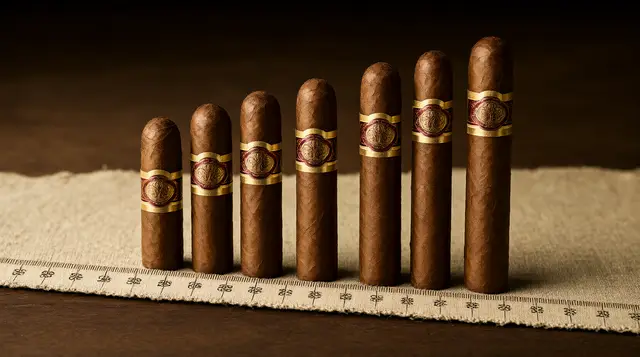
Size is the other half of a cigar's name. A vitola is the trade word for a named shape and size together, so calling a cigar a robusto tells you it is a straight-sided cigar of roughly 5 inches by a 50 ring gauge. Length is measured in inches, and ring gauge is the diameter in sixty-fourths of an inch, so a 64 ring cigar is an inch thick.

The sizes fall into rough families. The slim ones, the lancero and panatela, sit around a 38 ring and are the most wrapper-forward cigars you can smoke. The corona family runs about 42 to 46. The robusto and toro, around 50 to 52, are the modern middle and the most common sizes on any shelf. The gordo and its cousins push to 60 and beyond. Long and stately shapes like the churchill and lonsdale trade thickness for length.

One myth to drop right away: bigger is not stronger. A big cigar has more tobacco, so it lasts longer and usually burns cooler, but the strength comes from the blend, not the dimensions. The sizes chart has every common vitola with typical dimensions, millimeter conversions, and smoke times.

Types of cigars by wrapper color

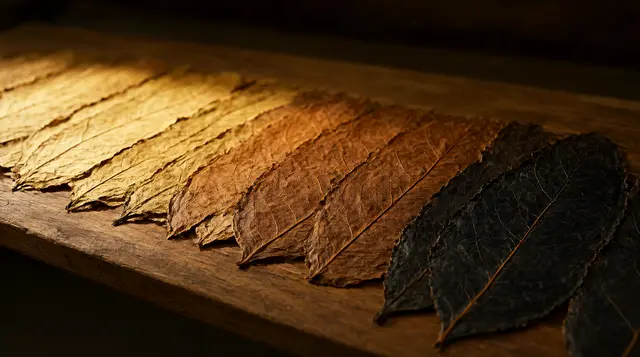
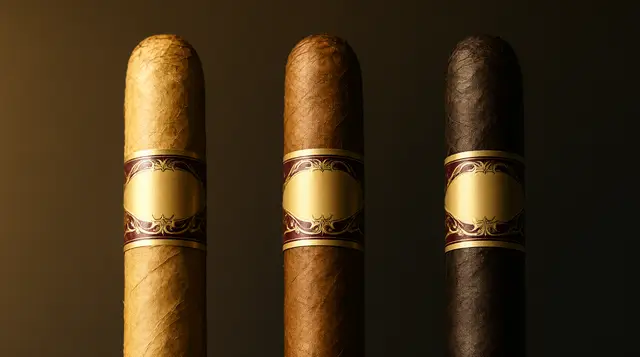
Wrapper color is the most visible way to sort cigars and the most misunderstood. The wrapper is the outer leaf, and its color runs on a scale from candela (green) through claro (pale tan), colorado (reddish brown), natural (the broad middle), maduro (dark brown), and oscuro (nearly black).

Color tracks flavor tendencies, not strength. Lighter wrappers lean creamy and gentle, darker ones lean sweeter and richer, with cocoa and coffee notes. What color does not tell you is how much nicotine is in the cigar, because the wrapper is one leaf and the filler does that work. Plenty of maduros are medium, and plenty of pale cigars are surprisingly strong.

Wrapper also has a second axis people forget: where the leaf was grown and from what seed, which is why you see names like Connecticut, Habano, Cameroon, and San Andrés on the band. The wrapper types guide covers both axes, color and origin, with a chart.

Types of cigars by strength

Strength is how hard the nicotine hits you, and cigars are usually sorted into mild, medium, and full, with steps like mild-to-medium and medium-to-full between them.

Strength lives mostly in the filler. The leaves from the top of the tobacco plant, often called ligero, get the most sun and carry the most potency, and blends that use more of them read stronger. That is why two cigars with the same wrapper can land at opposite ends of the scale.

Strength is also not the same as body. Body is how rich and heavy the smoke feels in your mouth, and a cigar can be full-bodied but only medium in strength, or the reverse. The strength chart explains the difference and maps both dials side by side, which is the most useful thing to understand before you buy a cigar you have never smoked.

Types of cigars by country

Country of origin is shorthand for a house style. Cuba is the original home of the premium cigar and the school of aroma and nuance. Nicaragua is the modern home of spice and strength. The Dominican Republic built its name on smoothness and consistency. Honduras sits between, often rich and earthy. Those are tendencies, not laws, and a great blender can make any of them taste like almost anything.

The complication is that most cigars are blends of several countries. The country on the box is usually where the cigar was rolled, while the wrapper might be grown in Ecuador, Connecticut, Mexico, Cameroon, Brazil, or Indonesia. A cigar made entirely from one country's tobacco is called a puro, and it is something makers like to advertise.

The Cuban, Nicaraguan, and Dominican comparison guide covers the three big origins head to head, including which one tends to suit which smoker.

Long filler, short filler, and mixed filler: types of cigars by construction

How a cigar is built is the dividing line between a premium cigar and everything else, and it matters more to how a cigar smokes than almost anything on the band.

The filler is the tobacco inside the cigar, held together by a binder leaf and covered by the wrapper. In a long-filler cigar, the filler is whole leaves running the full length. In a short-filler cigar, it is chopped leaf and trimmings. Mixed filler sits between the two.

Then there is how it is rolled. Handmade cigars are bunched and rolled by people, often with simple hand tools and a wooden mold to press the bunch. Machine-made cigars are produced on machines, usually with short filler, and sometimes with a wrapper made of reconstituted tobacco sheet instead of whole leaf. Cuba has precise words for this on its boxes: totalmente a mano means made totally by hand, hecho a mano can mean a machine-made bunch that was finished by hand, and mecanizado means machine-made. Outside Cuba, makers use the Spanish phrases more loosely, so do not read too much into them on a non-Cuban box.

What is a long filler cigar?

A long-filler cigar is filled with whole tobacco leaves that run the full length of the cigar, rather than chopped pieces. Long filler burns more evenly, holds a long ash, and lets the blend change gradually from start to finish. Nearly every premium handmade cigar is long filler, and in the US premium cigar definition at least half the filler by weight must be long filler.

What is a short filler cigar?

A short-filler cigar is filled with chopped leaf and trimmings instead of whole leaves, often scraps left over from making long-filler cigars. It is cheaper to make and is common in machine-made and budget cigars. Short filler tends to burn faster and hotter, can shed bits of tobacco onto your lips, and gives a flatter, less evolving smoke than long filler.

What is a mixed filler cigar?

A mixed-filler cigar combines long and short filler, most often as a core of chopped short filler wrapped in a layer of long-filler leaves. It is sometimes called a sandwich filler. The approach shows up in value cigars, where it delivers a burn and draw closer to long filler at a lower cost. It is a reasonable compromise, not a premium construction.

What is the difference between handmade and machine-made cigars?

Handmade cigars are bunched and rolled by people, usually with whole-leaf long filler, a natural leaf binder, and a whole-leaf wrapper. Machine-made cigars are produced on machines, usually with short filler and sometimes a wrapper or binder made of reconstituted tobacco sheet. Handmade cigars cost more and burn more evenly; machine-made cigars are cheaper and more uniform but rarely as complex.

What legally counts as a premium cigar in the US?

In April 2026 a federal court in Washington, D.C., re-adopted an eight-part definition. A premium cigar has a whole-leaf wrapper, a 100 percent leaf binder, and at least 50 percent long filler by weight. It is handmade, with no filter, tip, or mouthpiece and no characterizing flavor besides tobacco. It contains only tobacco, water, and vegetable gum, and weighs more than six pounds per thousand.
Why the premium cigar definition matters

This sounds like legal trivia, but it is one of the more consequential ways cigars got categorized in recent years. The FDA extended its tobacco rules to cigars in 2016, premium ones included. The industry sued, and in January 2025 a federal appeals court agreed the FDA had acted arbitrarily in sweeping premium cigars in, then sent the question of exactly what counts as premium back to the district court. In April 2026 that court re-adopted, unchanged, the eight-part definition the FDA itself had been working with.

The practical effect is a bright line. A flavored cigar, a tipped cigarillo, or a machine-made cigar is not a premium cigar, however it is marketed. One honest caveat: this is litigation, and the industry has also been lobbying Congress for a full exemption, so the details could still change. As of this writing, the April 2026 definition is the one that stands.

Cigars vs cigarillos vs little cigars vs flavored cigars

The last way to sort cigars is by what kind of product it is in the first place, and this is where everyday language gets slippery. Plenty of people use cigarillo and little cigar interchangeably, and in casual talk that is fine. The distinction that actually has teeth is a legal and tax one.

A premium cigar is the handmade, long-filler, whole-leaf product most of this site is about. A cigarillo is a short, slim cigar, thinner and shorter than a corona, and there is no single legal definition of one. Most are machine-made and many come with plastic or wooden tips, but handmade premium cigarillos exist too, sold in tins by several well-known makers. A little cigar is a cigarette-sized product, usually filtered and sold in packs, and US federal tax law defines small cigars as weighing no more than three pounds per thousand. Flavored or infused cigars are any cigars with an added flavor, from vanilla and coffee to sweetened tips, and aromatic is mostly a marketing word for the same thing.

For how all of these compare to cigarettes, including the inhaling question, the cigar vs cigarette guide covers it plainly.

Cigar formats compared. Casual usage blurs these; the legal lines are noted where they exist.
FormatWhat it isTypical sizeHow it is usually made
Premium cigarWhole-leaf wrapper, leaf binder, mostly long filler, no added flavorRoughly 4 to 7+ inches, about a 38 to 60 ringBy hand
CigarilloA short, slim cigar; no single legal definitionThinner and shorter than a coronaUsually machine-made, often tipped; handmade premium versions exist
Little cigarCigarette-sized, usually filtered, sold in packsDefined for US tax as no more than 3 pounds per 1,000Machine-made, often with a reconstituted tobacco wrapper
Flavored or infusedA cigar with an added characterizing flavor or sweetened tipAny sizeFlavor applied to the leaf, wrapper, or tip; excluded from the premium definition
"Aromatic"A marketing term for flavored, borrowed from pipe tobaccoAny sizeSame as flavored

Common questions

What are the different types of cigars?

Cigars are classified in seven main ways: shape (parejo or figurado), size (named vitolas like robusto and toro), wrapper color (claro to oscuro), strength (mild, medium, full), country of origin, construction (long or short filler, handmade or machine-made), and format (premium cigar, cigarillo, little cigar, flavored). Every cigar belongs to one type in each category at the same time.

What are the main cigar shapes?

There are two families. Parejos are straight-sided cylinders with a rounded cap, and they make up most cigars. Figurados are shaped: the torpedo and belicoso have pointed heads, the pyramid tapers along its whole length, the perfecto tapers at both ends, and rarer shapes include the salomon, diadema, culebra, and chisel. Box-pressed cigars are squared-off parejos.

What is the most common cigar shape?

The parejo, the straight-sided cylinder, by a wide margin. In the Cigarista catalog the two most-listed sizes are the toro and the robusto, both parejos, and the most common shaped cigar, the torpedo, appears roughly a third as often as the toro. If you walk into a shop without a plan, a robusto or toro is the safe, standard choice.

What is the difference between a cigar and a cigarillo?

A cigarillo is a small, slim cigar, shorter and thinner than a corona, usually smoked in well under half an hour. Most cigarillos are machine-made and many have plastic or wooden tips, though handmade premium cigarillos exist. A full-size premium cigar is handmade with whole-leaf long filler and takes anywhere from half an hour to two hours or more to smoke.

Are bigger or darker cigars stronger?

No to both. Strength comes from the filler blend, especially how much potent upper-plant ligero leaf it contains. A bigger cigar holds more tobacco, so it lasts longer and often burns cooler, but it is not inherently stronger. A darker wrapper tends to taste sweeter and richer, yet plenty of maduros are medium strength and some pale cigars are strong.

What type of cigar is best for a beginner?

A mild-to-medium, handmade, long-filler cigar in a straight robusto or corona shape. A parejo is the easiest to cut and light, a moderate size is a manageable sit, and long filler burns evenly. Save figurados, giant ring gauges, and full-strength blends for later. If someone hands you a cigar you do not recognize, Cigarista's scanner can identify it from a photo of the band.

Explore the catalog

More from the houses on this list

Every line, its specs and sizes, and what members have logged.

Head to head

Compare

Side-by-side comparisons that put this guide to work.

Keep reading

More guides like this

Smoke one off this list? Log it.

Snap the band, Cigarista identifies it, and your rating joins the cigar’s page. New members get 2 free scans. No card required.

Track a cigar →