Guide · Storage & aging
How to Rehydrate Cigars Without Cracking Them (and When a Dry Cigar Is Too Far Gone)
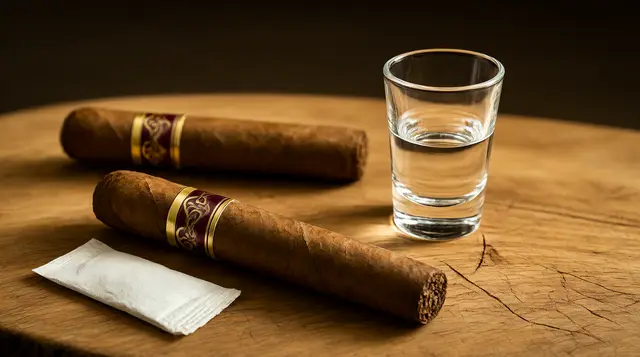
To rehydrate cigars, put them in a sealed container with a humidity pack at a moderate level, around 65 percent, and leave them there for several weeks, stepping up to your normal storage humidity only once they have softened. Slow is the whole method. Dry tobacco that takes on moisture too fast swells unevenly and splits the wrapper, which turns a dry cigar you could have saved into one you cannot.
Most dried-out cigars can be brought back, as long as the wrapper is intact and the tobacco is not crumbling. What you get back is the structure and the burn. What you may not fully get back is some of the aroma and the oils, and I would rather tell you that now than have you expect a miracle.
This page covers how to check whether a cigar is actually dry, the staged method with a week-by-week timeline, why the quick fixes on the internet ruin wrappers, how to tell when a cigar is too far gone, and the opposite problem: cigars that are too wet, and what dry boxing means.
How I picked these
The staged humidity steps follow Boveda's own published rehydration guidance (it recommends 65 percent for four weeks, then 69 percent for four weeks, for fragile wrappers) alongside the gradual approach that cigar retailers and experienced smokers have used for years. The signs of dryness and the honest limits on what comes back are from experience. Nothing here requires a product you do not already own beyond a bag and a humidity pack.
Can you rehydrate dry cigars?
Yes, in most cases. A cigar that has dried out in a forgotten drawer, a gift box, or a humidor whose packs quietly ran out is usually recoverable if two things are true: the wrapper is not cracked or splitting, and the tobacco does not crumble when you handle it gently. Tobacco leaf is meant to give up and take on moisture, and given enough time it will come back to a smokeable state.
The catch is the word time. Boveda puts it bluntly: cigars lose moisture about four times as fast as they can safely gain it back. A cigar that dried out over a couple of months can need a month or two to recover properly, and the people who ruin dry cigars are almost always the people who tried to do it in a weekend.
The other honest point is what you get back. Rehydration restores the physical cigar: the softness, the draw, the slow, even burn. It does not fully restore everything that evaporated while it sat dry. Much of a cigar's aroma lives in volatile compounds and oils, and some of those are simply gone. A cigar that dried out briefly may smoke nearly like new. One that sat bone dry for a year will usually smoke fine but taste flatter than it should. Both are worth rehydrating; just know which one you are holding.
Can dry cigars be rehydrated?
Yes, as long as the wrapper is intact and the tobacco is not crumbling. Seal them in an airtight container with a humidity pack around 65 percent, leave them for several weeks, then move them to your normal storage humidity. Go slowly, since fast rehydration cracks wrappers. Expect the burn and draw to recover fully, but some aroma lost while they sat dry may not come back.
How to tell if a cigar is dry
Use your hands and ears before anything else. Hold the cigar near your ear and roll it very gently between your fingers. A healthy cigar is quiet and has a slight give, a little like a firm sponge. A dry one crackles or crunches and feels hard, almost like a stick. Squeeze it lightly along its length: if there is no give at all, it has dried out.
Then look at it. A properly humidified wrapper has a slight sheen, a little oiliness that catches the light. A dry wrapper looks dull, matte, and sometimes papery, and the color can look paler. Check for fine cracks, especially near the cap and the foot, and for a wrapper that has started to lift or flake.
The smell is a clue too. A healthy cigar smells like tobacco, leathery or sweet or earthy. A very dry one often smells faint, dusty, or of almost nothing.
The last test is smoking it, and you will know. A dry cigar burns fast and hot, the smoke turns harsh and thin, and the ash is often flaky. If you have a box and want to check without wasting one, rehydrate them all anyway: it does no harm to a cigar that turns out to be fine.
| Check | Healthy cigar | Dry cigar |
|---|---|---|
| Gentle squeeze | Slight, springy give | Hard, no give at all |
| Roll near your ear | Quiet | Crackles or crunches |
| Wrapper look | Slight oily sheen | Dull, matte, sometimes papery or paler |
| Wrapper condition | Smooth and tight | Fine cracks, lifting or flaking near the cap or foot |
| Smell | Clearly tobacco: leathery, sweet, earthy | Faint, dusty, or almost nothing |
| Smoking | Slow, even burn with cool smoke | Fast, hot burn, harsh and thin, flaky ash |
Why fast rehydration cracks wrappers
A cigar is not one material. It is a bunch of folded filler leaves, held by a binder leaf, wrapped in a single thin, stretched wrapper leaf. When dry tobacco takes on water, it swells, and those layers do not swell at the same rate. If moisture rushes in, the filler expands underneath a wrapper that cannot stretch to keep up, and the wrapper splits, often in a long crack running up the side. Once that happens, the cigar tends to unravel as it burns.
That is why every quick fix you will find online is a bad idea. A wet paper towel wrapped around the cigar, a damp sponge in a bag, steaming it over a kettle, misting it with a spray bottle, or tossing it straight into a humidor running in the mid 70s: all of them push a lot of moisture into the outside of the cigar fast, which is precisely the condition that splits wrappers. Boveda specifically warns against wet sponges, crystals, beads, and submersion for this reason.
It is also why I would not put very dry cigars straight into a well-stocked humidor at 69 or 70 percent, even though that sounds gentle. Compared to a cigar sitting at 40 or 50 percent, that is a big jump. Starting a few points lower and stepping up gives the inside of the cigar time to catch up with the outside.
How to rehydrate cigars: the slow method, step by step
Here is the method I would use. You need an airtight container, a thick freezer bag or a gasketed tupperdor, and a humidity pack or two.
Start low. Put the dry cigars in the container with a 65 percent humidity pack and seal it. Boveda's recommendation for fragile wrappers is exactly this: 65 percent for four weeks, then 69 percent for four weeks. If the cigars are only mildly dry, Boveda says a single month at 69 percent usually does it, but I would still start at 65 for anything that crackles, because there is no downside to going slower.
Use enough humidity. One large (Size 60) pack per 25 cigars or fewer is Boveda's guidance. Dry cigars soak up a lot of moisture, and a pack that goes hard early needs replacing.
Leave them alone. Check once a week. Turn the cigars or rotate their positions so they rehydrate evenly, and look for any sign of mold, which should not appear at 65 percent but is worth watching for. Do not keep opening the bag to squeeze them; every opening is a small humidity drop.
Step up. Once the cigars have a slight give again and no longer crackle, usually after three or four weeks, swap to your normal storage level, 65 to 69 percent for most people, or move them into your humidor.
Rest, then test. Give them a couple more weeks at storage humidity before you judge them, then smoke one. If it still burns hot and fast, leave the rest for another few weeks.
Two debated details. Some smokers leave the cellophane on very dry cigars for the first stage, because it slows moisture uptake, then remove it once the cigar softens a little. Others say remove it from the start because it slows things down too much. For truly rock-hard cigars I lean toward leaving it on at first; for mildly dry ones, take it off. And if you have no spare container, the old humidor version works: put the dry cigars at the far end of your humidor, away from the humidifier, and move them a little closer each week.
Finally, write down the date you started. A month is long enough to forget, and guessing is how cigars get pulled out too early. I log them in Cigarista so the resting time is right there when I am deciding whether one is ready.
| When | Where | What to look for |
|---|---|---|
| Day 1 | Sealed bag or tupperdor with a 65% pack | Wrapper intact; tobacco not crumbling. If either fails, see the too-far-gone section |
| Weeks 1 to 2 | Same container, unopened except a weekly check | Little visible change; cigars may still feel hard. Rotate them weekly |
| Weeks 3 to 4 | Same container | Slight give returning, less crackle, wrapper sheen starting to come back |
| Weeks 4 to 8 | Step up to 69% or your normal humidor | Soft give, quiet when rolled, wrapper looks healthy |
| Weeks 6 to 10 | Normal storage | Test-smoke one. Slow, even burn means the rest are ready; hot and fast means wait longer |
How long does it take to rehydrate cigars?
It depends on how dry they got and for how long. A cigar that spent a few days out of a humidor on a trip may only need a week or two back in normal storage. A box that dried out over a couple of months will usually need around one to two months with the staged method. Cigars that sat bone dry for a long time can take longer, and some retailers suggest planning on up to two months for very dry cigars.
The useful rule is that rehydration takes much longer than drying. If it took three months to dry out, do not expect it back in three weeks. When in doubt, wait. A cigar left in storage a little longer than necessary loses nothing, and one smoked too early wastes the whole effort.
How long does it take to rehydrate a dry cigar?
Usually about one to two months for a properly dried-out cigar, and a week or two for one that was only out of storage for a few days. Boveda suggests 65 percent for four weeks then 69 percent for four weeks for fragile wrappers. Rehydration is slower than drying, so when in doubt give it longer; extra time costs nothing.
Can you rehydrate a cigar overnight?
No. Any method fast enough to work overnight, such as a damp paper towel, steam, or a very humid box, pushes moisture into the wrapper faster than the filler can absorb it, and the wrapper splits. Real rehydration takes weeks. If you want to smoke a slightly dry cigar tonight, smoke it slowly with longer gaps between puffs to keep it from burning hot.
When is a dry cigar too far gone?
Some cigars are not worth the wait. The clear signs are a wrapper that is already cracked open along its length, a wrapper that is peeling away or flaking off in pieces, tobacco that crumbles or falls out of the foot when you handle it, and a cigar that has no smell left at all. Boveda describes cigars with cracked wrappers that are spilling tobacco as possibly beyond repair, and I agree.
A small crack near the foot is a judgment call. Rehydrate it with the others. If it holds together after the process, smoke it from the cracked end first, or trim a little off the foot. A cracked cap can sometimes be managed by cutting below the damage. A crack that runs up the body will usually open further and unravel as it burns.
And separate dryness from other damage. Tiny round pinholes and tobacco dust are tobacco beetles, not dryness, and the freezing guide covers what to do. Fuzzy growth is a mold question, covered in the plume vs mold guide. Neither is fixed by rehydration.
If you are unsure, try it. The cost of rehydrating a cigar that turns out to be ruined is a few weeks and a humidity pack. The cost of throwing out one that would have come back is the cigar.
The opposite problem: over-humidified cigars and dry boxing
Cigars can also be too wet, and it is more common than people think, especially in humidors run at 72 percent or higher, in a new humidor right after seasoning, or after a shipment packed with a high humidity pack. Over-humidified cigars feel spongy or soft when squeezed, draw tight, are hard to light and harder to keep lit, burn unevenly, and can taste sour or bitter. In bad cases the wrapper swells and splits, the same failure as rehydrating too fast.
The fix is dry boxing. It means resting cigars outside the humidor in an empty, unhumidified container for a short while before smoking, so they shed some surface moisture. An empty cigar box with the lid closed is the classic choice; a drawer or any closed container with no humidity pack works too. The goal is not to dry the cigar out, just to bring it back from soggy to normal.
How long is a matter of taste and of how wet they were. Overnight is a common starting point; one to two days for cigars that are noticeably spongy; a little longer for badly over-humidified ones. Many smokers dry box routinely for a few hours or a day even when nothing is wrong, because they like the firmer burn. The simple way to find your number is to take three of the same cigar, smoke one straight from the humidor, one after a day in the box, and one after two days, and see which you prefer.
Do not overdo it. Leave a cigar out for a week and you are back at the start of this page with a dry cigar. And if your cigars are consistently too wet, dry boxing is a patch, not the fix: bring the humidor's humidity down, which the humidity guide covers.
What does dry boxing a cigar mean?
Dry boxing means resting a cigar outside the humidor in an empty, unhumidified container, often an empty cigar box, for a short time before smoking, so it sheds excess moisture. Overnight to two days is typical. It fixes over-humidified cigars that draw tight or burn unevenly, and some smokers do it routinely for a firmer burn. Leaving cigars out much longer dries them out.
How do you fix an over-humidified cigar?
Dry box it: rest it in an empty, closed container without a humidity pack for about a day or two, until it feels firm with a slight give instead of spongy. Then smoke it or return it to a humidor at a lower humidity. If all your cigars are too wet, lower the humidor's humidity by removing a pack or switching to a lower RH.
Common questions
How do you revive dry cigars?
Slowly. Seal them in an airtight bag or container with a humidity pack around 65 percent for about four weeks, then move them to 69 percent or your normal humidor for several more weeks. Check weekly and rotate them. Avoid wet paper towels, steam, sponges, or a very humid box, which split wrappers. Test-smoke one before judging the rest.
Can you smoke a dry cigar?
You can, but it will not smoke well. A dry cigar burns fast and hot, which makes the smoke harsh and thin, and the wrapper may crack when you cut or light it. If you must smoke one, puff slowly with longer pauses to keep it from overheating. If you can wait, rehydrating it over a few weeks gives a much better smoke.
Do dry cigars lose their flavor permanently?
Partly. Rehydration restores the burn, the draw, and the cigar's structure, but some aromatic compounds and oils evaporate while a cigar sits dry, and those do not come back. A cigar that dried briefly often smokes close to new. One that sat bone dry for a long time usually smokes fine but tastes flatter than it should.
What humidity should I use to rehydrate cigars?
Start around 65 percent and step up to your normal storage level, usually 65 to 69 percent, once the cigars have softened. Boveda recommends 65 percent for four weeks and then 69 percent for four weeks for fragile wrappers. Avoid going high, in the mid 70s or above, to speed things up; that is how wrappers crack and mold starts.
Can you rehydrate cigars with a damp paper towel?
Do not. A damp paper towel pushes moisture into the wrapper far faster than the filler underneath can absorb it, so the wrapper swells, stretches, and often splits. It also risks mold. The safe method is a sealed container with a humidity pack around 65 percent, left for several weeks, then stepped up to normal storage humidity.
Should you leave the cellophane on when rehydrating cigars?
It is debated. Some smokers leave cellophane on very dry cigars for the first stage because it slows moisture uptake and lowers the risk of cracking, then remove it once the cigar softens. Others remove it from the start because it slows rehydration too much. For rock-hard cigars I leave it on at first; for mildly dry ones I take it off.
Why did my cigar crack after I put it in the humidor?
Most likely it went from dry to humid too fast. When a dry cigar takes on moisture quickly, the filler swells faster than the thin wrapper can stretch, and the wrapper splits. It can also happen in a humidor running too high. Bring dry cigars up gradually, starting around 65 percent, and keep your humidor steady in the 62 to 70 percent range.
Explore the catalog
Start browsing the catalog
Every line, its specs and sizes, and what members have logged.
Keep reading
More guides like this
Smoke one off this list? Log it.
Snap the band, Cigarista identifies it, and your rating joins the cigar’s page. New members get 2 free scans. No card required.