Guide · Storage & aging
Cigar Humidity: The Right Level, the 70/70 Rule, and Which Boveda to Buy
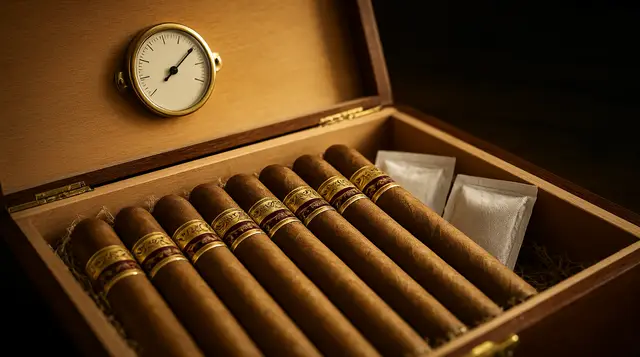
The right cigar humidity is somewhere between about 62 and 70 percent relative humidity, held steady, at a temperature in the mid to high 60s Fahrenheit. Within that range the number you pick is a matter of taste: the low 60s give a firmer, quicker-burning cigar, and the high 60s give a softer, fuller one.
Most pages stop at "use 70/70" and move on. That rule is fine, but it is no longer what a lot of experienced smokers actually run, and the reasons why are worth knowing before you buy a box of humidity packs. So this page goes through the full picture: what each humidity level does to the way a cigar smokes, the honest state of the 65 versus 70 debate, which Boveda number fits which setup, why temperature matters more than people think (beetles included), and how to tell whether your hygrometer is lying to you.
If your humidor is new and empty, start with seasoning it, and if your cigars have already dried out, there is a separate guide on rehydrating them slowly. Both are linked at the bottom. This one is about the number itself and keeping it where you want it.
How I picked these
I pulled the manufacturer figures straight from the source where one exists: Habanos for its official storage conditions, Boveda for what each of its humidity levels is meant for and how its calibration kit works. The burn and draw descriptions are what I and most smokers I know have seen over years of running humidors at different numbers. Where the hobby genuinely disagrees, I have said so rather than picking a winner for you.
What humidity should cigars be stored at?
Between about 62 and 70 percent relative humidity (RH), with most people landing somewhere around 65. Habanos, the company that markets Cuban cigars, gives 65 to 70 percent RH at 16 to 18 degrees Celsius (roughly 61 to 64 degrees Fahrenheit) as its official storage conditions, which is a useful anchor because it comes from the people who make the cigars rather than the people who sell humidity products.
The more important word is steady. A cigar is a bundle of leaves that soaks up and gives off moisture constantly, and every swing makes the wrapper and the filler expand and contract at slightly different rates. A humidor that sits flat at 67 is doing a better job than one that averages 65 but bounces between 60 and 72 every time the seasons change.
Here is what each band actually does to the smoke. Treat the edges loosely: a robust Nicaraguan maduro and a thin Connecticut shade wrapper do not respond identically, and your hygrometer is probably off by a point or two anyway.
| Relative humidity | How the cigar feels and smokes | Main risk |
|---|---|---|
| Below 60% | Stiff, crackly, burns fast and hot, harsh and thin on flavor | Cracked or unraveling wrappers; needs slow rehydration |
| 60 to 64% | Firm, lights easily, burns quickly and evenly, sharp and lively flavor | Fragile wrappers can feel brittle at the low end |
| 65 to 67% | Slight give when pressed, open draw, even burn; where many experienced smokers settle | Very little, as long as it stays steady |
| 68 to 70% | Softer, fuller, slower smoke; classic 70/70 territory | Some dense or box-pressed cigars draw tight or go out more |
| 71 to 75% | Spongy, tight draw, tunnels or canoes, struggles to stay lit, can taste sour | Mold becomes a real concern, especially when warm |
| Above 75% | Swollen, wrapper may split, bitter and hard to keep burning | Mold is likely, and warmth plus moisture invites beetles |
What is the best humidity for cigars?
For most people, around 65 percent relative humidity, held steady. That level gives an even burn and an open draw with very little mold risk. Anywhere from about 62 to 70 percent is a reasonable choice: lower gives a firmer, quicker-burning cigar, and higher gives a softer, fuller smoke. Habanos officially recommends 65 to 70 percent at 61 to 64 degrees Fahrenheit.
The 70/70 rule, and why a lot of smokers now go lower
The 70/70 rule says to keep cigars at 70 percent humidity and 70 degrees Fahrenheit. It is easy to remember, it sits inside the range manufacturers recommend, and it will not ruin anything. For decades it was simply the answer.
Plenty of experienced smokers, me included, have since drifted down to somewhere between 62 and 67 percent. The reasons are practical. Cigars at 70 percent tend to draw tighter, burn less evenly, and go out more often, because swollen filler leaves less room for air to move through. Drop a few points and the same cigars light easier, burn straighter, and many people find the flavor sharper and more defined. A lower number also gives you more margin against mold, which matters if your house runs warm in summer. Cuban cigar smokers in particular tend to run lower, partly because Cuban cigars are often rolled tightly, and Boveda itself now recommends its 65 percent pack for drier smoking and long-term aging.
Now the other side, because it is a real one. Some smokers find cigars at 62 to 65 percent burn too fast and hot, and that delicate wrappers like Connecticut shade or Cameroon get brittle and crack. They like the softer, rounder, slower smoke of the high 60s and see no reason to change. Neither camp has a controlled study behind it. This is preference backed by a lot of personal experience on both sides.
My honest advice: start at 65 to 69, smoke a few cigars, and adjust. If your cigars keep tunneling, drawing tight, or going out, go down. If they burn hot and the wrappers flake, go up. The right number is the one that makes your cigars smoke well in your climate, not the one a forum argued about.
What is the 70/70 rule for cigars?
The 70/70 rule is the traditional advice to store cigars at 70 percent relative humidity and 70 degrees Fahrenheit. It is a safe, easy-to-remember starting point that will not harm cigars. Many experienced smokers now run lower, around 62 to 67 percent, for a firmer draw and more even burn, and keep temperature in the mid 60s to reduce beetle risk.
How humidity affects burn, draw, and flavor
Moisture changes the physical cigar, and the physical cigar decides how it smokes. Tobacco leaf swells as it absorbs water. In a well-rolled cigar the filler leaves are folded with small air channels between them, and those channels are your draw. Push the humidity up and the leaves swell into those channels, so the draw tightens and the cigar needs more effort to stay lit. Wet tobacco also burns cooler and slower, and if it is too wet it smolders unevenly, which is where tunneling and canoeing come from.
Go too dry and the opposite happens. The leaf shrinks, the draw opens up, and the cigar burns fast and hot. Heat is the enemy of flavor in a cigar: a hot burn scorches the tobacco and pushes the smoke toward harsh and bitter, and it chews through the subtle notes you paid for. Very dry wrappers also crack, sometimes the moment you cut the cap.
Flavor sits in the middle of all this. Most of the aromatics in a cigar are carried by its oils and volatile compounds, and both survive best when the leaf is neither soaked nor dried out. That is the real reason humidity control matters: not because a cigar at 64 percent is ruined and one at 68 is perfect, but because both ends of the range quietly take flavor away, one by scorching and one by muffling.
If burn problems show up on cigar after cigar from the same humidor, humidity is the first thing I would check.
Boveda 62, 65, 69, or 72: which humidity pack should you buy?
Boveda packs are two-way humidity packs: a salt solution sealed behind a membrane that releases moisture when the air is dry and absorbs it when the air is wet, holding the space at the number printed on the pack. Boveda says they hold within about 2 percent when you use enough of them, and its usual sizing is one large (Size 60) pack for every 25 cigars your humidor holds. They need no distilled water and no fiddling, and when a pack turns hard and crunchy it is spent.
Here is what Boveda says each level is for, alongside how I would think about it. One practical note first: in a wooden humidor the hygrometer often settles a point or two below the number on the pack, because the cedar keeps absorbing moisture. A sealed plastic tupperdor tends to read right on the number. Do not mix different numbers in the same box. Pick one.
| Boveda RH | What Boveda says it is for | Who it suits |
|---|---|---|
| 62% | Not on Boveda's current cigar chart, though tobacco-size 62% packs are sold through cigar shops | Smokers who want the firmest, quickest-burning cigar, usually in an airtight container |
| 65% | A drier profile and easier burn; good for long-term aging; recommended for Cuban cigars | The low-humidity camp, Cuban cigar storage, tight-sealing humidors and tupperdors |
| 69% | The default for most cigar storage: wood and acrylic humidors, tupperdors, coolerdors, humidor bags | First-time buyers and anyone who wants a safe middle |
| 72% | Drafty humidors, dry environments, or humidors that struggle to hold their RH | Older or leaky wood boxes, very dry homes, fragile wrappers |
| 75% | Extremely dry conditions such as deserts or high altitude; not for airtight containers | Rarely needed; desert climates with a wood humidor |
| 84% | Seasoning a wood humidor only, never for storing cigars | A new or long-dry wood humidor, before any cigars go in |
Boveda 65 or 69 for cigars?
Choose 69 if you want the safe default or your humidor is wood and not perfectly sealed, since it will often read a little lower in practice. Choose 65 if your cigars tend to draw tight or tunnel, you store Cuban cigars, or you use an airtight tupperdor. Both are reasonable. The difference is mostly a firmer, quicker burn at 65 versus a softer, fuller smoke at 69.
Boveda 69 or 72 for cigars?
Use 69 unless your humidor will not hold humidity. Boveda positions 72 for drafty humidors, dry environments, and boxes that struggle to stay at their target, where the extra pull compensates for leaks. In a tight-sealing humidor or tupperdor, 72 tends to leave cigars spongy and slow to burn. If your hygrometer reads in the low 60s with 69 packs, try 72.
Boveda 62 vs 65 vs 69: what is the difference?
They are three points along the same range. At 62 percent cigars are firm, light easily, and burn fast and sharp, with some risk of brittle wrappers. At 65 they are slightly softer with an even burn, the level many experienced smokers prefer. At 69 they are softer still with a slower, rounder smoke, which is Boveda's default recommendation. None of them is wrong; it is a taste call.
What temperature should a humidor be? (and why beetles care)
Aim for somewhere in the mid to high 60s Fahrenheit, and below the low 70s. Habanos recommends 61 to 64 degrees Fahrenheit for its cigars, which is cooler than most homes run, and that is fine as a target to lean toward rather than a requirement. What you really want to avoid is a humidor sitting in the 70s for weeks at a time.
The reason is the tobacco beetle, also called the cigarette beetle. Its eggs can ride along invisibly in tobacco from the farm onward, and warmth is what wakes them up. Hobby sources usually put the danger line at roughly 72 to 75 degrees, and Tobacconist University says they typically hatch in conditions over 73 degrees with high humidity. Here is the part most guides leave out: lab research on this beetle (Fletcher and Long, 1976) found eggs still hatching at about 65 degrees Fahrenheit, just more slowly, taking around 17 to 25 days. So the 72 degree line is not a wall. Cooler storage slows beetles down a lot rather than making them impossible, which is why steady, cool storage plus a freeze for any suspect box is the belt-and-braces approach.
Temperature and humidity also interact. Relative humidity is relative to the air's temperature, and warm, damp air is what mold loves. A humidor at 70 percent in a cool basement is a very different thing from one at 70 percent next to a sunny window in July. If your house runs warm, that alone is a good argument for running humidity a few points lower.
Practical placement matters more than any gadget. Keep the humidor away from windows, radiators, heating and AC vents, and exterior walls. An interior closet is often the most stable spot in a house.
What temperature do tobacco beetles hatch at?
The commonly cited danger zone is roughly 72 to 75 degrees Fahrenheit with high humidity, and Tobacconist University puts typical hatching above 73 degrees. That is a rule of thumb, not a hard limit: a 1976 lab study found cigarette beetle eggs still hatching at about 65 degrees, just more slowly. Keeping storage cool and steady slows them down; freezing is the fix for an infestation.
Is your hygrometer accurate? How to calibrate it
Probably not exactly, and that is fine as long as you know how far off it is. Every humidity decision you make rests on the hygrometer, so a cheap gauge that reads 70 when the box is really at 63 will have you chasing a problem that does not exist.
There are three common types. Analog dial hygrometers, the brass or wood-faced ones built into many gift humidors, are the least trustworthy: they can be off by several points out of the box and drift over time, though some have an adjustment screw on the back. Basic digital hygrometers are usually more consistent and cost very little, but quality varies and many have no adjustment, so you just remember the offset. Smart sensors that send readings to your phone are the most useful kind, not because they are magically more accurate but because they show a history, and a history is how you spot swings you would otherwise never see.
Whatever you use, test it. There are two standard ways.
The Boveda calibration kit is the no-mess option. It is a sealed bag preloaded with a 75 percent humidity pack. You put the hygrometer inside, seal it, and leave it for at least 24 hours somewhere between 65 and 75 degrees Fahrenheit. Then read it without opening the bag. If it says 75, it is accurate. If it says 72, it reads 3 low, and you either adjust it or add 3 to every reading from now on. Boveda suggests rechecking every six months.
The salt test does the same thing for almost nothing. Put a bottle cap or small dish of ordinary table salt in a zip bag, add a few drops of water until the salt is damp like wet sand but not dissolved into a puddle, and seal the hygrometer in with it. A damp salt slurry holds the air in a sealed space at about 75 percent humidity. Leave it at a steady room temperature for 12 to 24 hours, read it through the bag, and note the difference from 75. If the reading is still moving, give it longer.
I keep a simple log of my humidor readings, the offset of each hygrometer, and the dates I swap packs, because patterns only show up over weeks. Cigarista already keeps track of what is in my humidor and how long each cigar has been resting, so between the two I always know whether a cigar that smoked badly sat through a dry spell.
How do you calibrate a hygrometer?
Seal it in a bag with a known humidity source for 12 to 24 hours and compare. A Boveda calibration kit holds 75 percent; so does a bottle cap of table salt dampened to a wet-sand consistency. Read the hygrometer through the bag: if it shows 72, it reads 3 points low. Adjust it if it has a screw or setting, or add the offset to future readings.
Humidor humidity too high? How to bring it down
First, confirm it. Calibrate the hygrometer before you change anything, because a gauge reading a few points high is the most common cause of a "too humid" humidor. Also check whether you just seasoned the box: a humidor fresh off 84 percent seasoning packs or a water seasoning will read high for days and settle on its own.
If it really is high, take away the source. Remove one Boveda pack, or swap to a lower number. If you use a sponge, foam, or bead humidifier, take it out until the reading comes down, then put it back less charged. Too many packs for the box size is a common cause, especially after you have smoked half the cigars that used to be absorbing the moisture.
To pull it down faster, leave the lid cracked open for a few hours at a time and check often, or add something dry that will absorb moisture, such as a few dry Spanish cedar sheets or an unseasoned cedar spill. Do not leave the lid open overnight in a dry house; you can overshoot in the other direction.
Then look at the cigars. If they feel spongy or soft when you squeeze them gently, they are carrying extra water, and resting them a day or two in an unhumidified box before smoking (dry boxing) will help. Check every cigar for fuzzy white or colored growth, especially on the foot, and if you find any, the plume vs mold guide covers how to tell the difference and what to do.
Humidor humidity too low? How to raise it
Again, calibrate first. If the reading really is low, work through the causes in order, because adding more water to a box that leaks is a losing game.
Check the seal. Close the lid on a dollar bill and pull it out: if it slides out with no resistance, the lid is not sealing well in that spot. Try it at several points around the lid. Gift humidors with warped lids are a common culprit. A leaky humidor will always fight you, and either needs more humidity capacity or a gasketed tupperdor instead.
Check capacity. One Size 60 pack per 25 cigars of capacity is the usual guidance; a 100-count box running on a single pack will sag. Replace any pack that has gone stiff. In a drafty wood box or a very dry climate, stepping up from 69 to 72 is exactly what Boveda's 72 is for.
Check the location. Heating season dries a house hard, and a humidor near a vent or radiator will lose the battle every winter. Moving it to an interior closet can do more than any new gadget.
Check the wood. If a wooden humidor sat empty and dry for months, the cedar may be soaking up everything you add, and it needs re-seasoning before it will hold steady. The seasoning guide covers that. And if the cigars themselves have dried out, do not just throw them back into a freshly humid box: bring them back up slowly, which the rehydration guide walks through step by step.
Common questions
What humidity should a humidor be?
Somewhere between 62 and 70 percent relative humidity, kept steady. Around 65 percent is where many experienced smokers settle for an even burn and low mold risk, while 69 to 70 percent gives a softer smoke and is the traditional target. Pick a number in that range, hold it with humidity packs or a humidifier, and confirm it with a calibrated hygrometer.
Can cigar humidity be too high?
Yes. Above about 72 percent, cigars tend to swell, draw tight, burn unevenly, and go out, and above 75 percent mold becomes likely, especially in a warm room. Wrappers can also split as the filler swells. If your hygrometer reads high, calibrate it first, then remove a humidity pack or switch to a lower RH until it settles.
Is 60 percent humidity too low for cigars?
It is at the dry edge but not ruinous. Cigars at 60 percent burn fast and can taste hotter, and delicate wrappers may crack, but many robust cigars smoke fine there. Below 60 for long periods is where real drying starts. If your humidor sits around 60, add humidity capacity or step up a Boveda level and let it climb gradually.
Do cigar humidity packs work?
Yes, two-way humidity packs like Boveda are the easiest reliable way to hold a humidor steady. They release or absorb moisture to hold the air near the printed number, need no distilled water, and last a few months in a humidor. Use enough of them, usually one large pack per 25 cigars of capacity, and replace them when they turn hard.
Does humidity affect cigar flavor?
Yes, indirectly. Too dry and the cigar burns fast and hot, which scorches the tobacco and pushes the smoke toward harsh and bitter. Too wet and it burns cool and uneven, muting the flavor and sometimes tasting sour. Somewhere in the middle of the 62 to 70 percent range, where the oils and aromatics are best preserved, the cigar tastes most like itself.
Should Cuban cigars be stored at lower humidity?
Many smokers think so. Boveda recommends its 65 percent pack for Cuban cigars, and plenty of Cuban cigar smokers run 62 to 65 percent because Cuban cigars are often rolled tightly and draw better a little drier. Habanos itself officially recommends 65 to 70 percent at 61 to 64 degrees Fahrenheit, so the low end of its own range is a safe target.
Explore the catalog
Start browsing the catalog
Every line, its specs and sizes, and what members have logged.
Keep reading
More guides like this
Smoke one off this list? Log it.
Snap the band, Cigarista identifies it, and your rating joins the cigar’s page. New members get 2 free scans. No card required.