Guide · Storage & aging
How to Organize a Humidor So You Can Find (and Age) What You Own
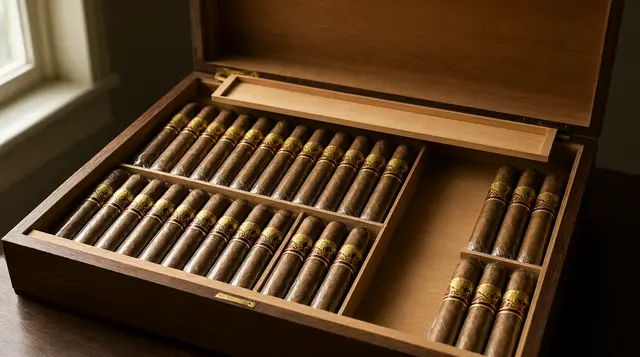
Organize a humidor by when you plan to smoke each cigar, not by brand: ready-to-smoke cigars on top where you can reach them, cigars you are aging underneath, and anything flavored or infused in a separate container altogether. Leave about a quarter of the space empty so air can move, label what you can with a date, and rotate the stock every month or two.
That system works in a twenty-count desktop box and in a cabinet. The rest of this guide covers the details people actually argue about: cellophane on or off, whether cigars really swap flavors, how to label singles, and how to keep track once you can no longer see everything at a glance.
Most humidor advice is about humidity. This is about the other problem, which is opening the lid and not knowing what half of it is.
Sort by when you will smoke it
Sorting by brand looks tidy and does not help you. When you open a humidor you are answering one question, which is what to smoke tonight, so arrange the box to answer it.
Three zones are enough.
Smoke now. The top tray or the front row. Cigars that have rested and that you would be happy to pick up any evening. This is the only zone you should need to touch on a normal day.
Resting. New arrivals. Cigars that have just been shipped or bought need time to settle to your humidor's humidity, a couple of weeks at least and longer if they arrived noticeably wet or dry. Keep them apart so you do not smoke one too early and blame the cigar.
Aging. The bottom of the box. Cigars you are deliberately putting away for months or years, and the special ones you are saving. They get handled least, which is what you want.
Inside each zone, group by size if you like, since similar lengths stack better. In a larger humidor you can also split the smoke-now zone into milder and fuller, so the choice between a morning cigar and an after-dinner one is a choice between two rows.
| Zone | Where | What goes there | How often you touch it |
|---|---|---|---|
| Smoke now | Top tray or front row | Rested cigars you would smoke any day | Every time you open the lid |
| Resting | Middle, or one divided section | New purchases settling in | When they graduate, after a few weeks |
| Aging | Bottom | Boxes and singles you are putting away | Only when you rotate |
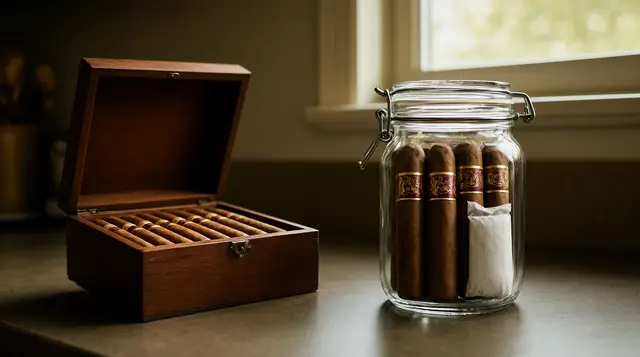
| Separate container | Not in this humidor | Flavored and infused cigars | Whenever you like |
Do cigars share flavors in a humidor?
For ordinary premium cigars, not in any way you need to plan around. A maduro next to a Connecticut for a year will still taste like a maduro and a Connecticut. People store mixed humidors for decades without trouble, and you do not need dividers between every blend.
The real exception is flavored and infused cigars. Anything with added aroma, the sweet, coffee, vanilla, or herbal infused lines, will scent its neighbors and the cedar, and the cedar holds on to it for a long time. Keep those in their own container. A sealed plastic box with a humidity pack is the usual answer, and it costs a few dollars.
Some collectors also keep Cuban and non-Cuban cigars apart, or separate very strong cigars from mild ones. That is preference, and it does no harm, but it is not a rule you are breaking if you ignore it.
Can you store different cigars together in a humidor?
Yes. Different brands, wrappers, and strengths of regular premium cigars can share a humidor without a meaningful effect on flavor. The exception is flavored or infused cigars, which should be stored in a separate container because their aroma transfers to other cigars and to the cedar lining.
Cellophane on or off
This is the longest-running argument in the hobby, and the honest answer is that both work.
Cellophane is not airtight. Moisture passes through it, more slowly than through bare leaf, so a cigar in cello still humidifies and still ages. Leaving it on protects the wrapper from being chipped when you dig around, stops a cracked foot from shedding tobacco over everything, and gives you a surface to write on or stick a label to. In a humidor that gets rummaged through, that protection is worth a lot.
Taking it off lets the cigar respond to the humidor a little faster and is the traditional choice for long aging. It also looks better, if that matters to you.
A reasonable split: keep the cello on in the smoke-now zone, where cigars get handled, and decide for yourself in the aging zone. If a cigar came without cellophane, as most Cubans do, just handle it less.
Tubes are different. An aluminum or glass tube with the cap on really is close to sealed, so either take the cap off or take the cigar out if you want it to share the humidor's humidity.
Label everything with a date
The single most useful habit is putting a date on cigars as they go in. You will not remember whether those have been in there four months or fourteen, and the answer changes how they smoke.
For singles in cellophane, write the month and year on the cello with a fine permanent marker, down near the foot, or use a small removable sticker. For cigars without cello, a thin strip of masking tape folded loosely around the cigar as a second band works, as long as the adhesive touches only itself and never the wrapper.
For boxes, write the date you bought it on the bottom or inside the lid. Cuban boxes already carry a factory code and a box date stamped on the underside, which tells you when they were packed.
If a band is missing and you do not know what a cigar is, label it anyway with whatever you do know, even if that is only where it came from. An unlabeled mystery cigar tends to sit at the bottom for years because nobody knows whether it is worth an evening.
Do not pack it full, and rotate
A humidor works by moving humid air around the cigars. Pack it to the lid and the cigars near the humidity source get damp while the ones in the far corner dry out. As a working rule, fill it to about three quarters and leave gaps between rows where you can. If you keep running out of room, that is the sign to get a second container, not to squeeze harder.
The same uneven air is the reason to rotate. Every month or two, move the bottom cigars to the top and the back ones to the front. It takes two minutes, evens out the humidity each cigar has seen, and it puts every cigar in your hands, which is how you catch a cracked wrapper or a spot of mold before it spreads. It is also when you find the cigars you had forgotten.
Keep the hygrometer away from the humidity source, on the opposite side or a different level, so it reads the box and not the pack sitting next to it.
When you cannot see everything anymore
Physical organization gets you to about fifty cigars. Past that, or as soon as you have two containers, the layout stops being enough, because you cannot see what is in the bottom tray of the other box without unpacking it. That is when people buy a second box of something they already own.
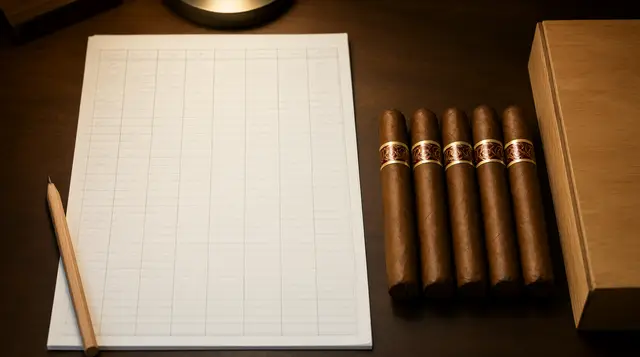
The fix is a list that lives outside the humidor: what you have, how many, where it is, and when it went in. A notebook works. A spreadsheet works better, and there is a guide to setting one up linked below.
I make a humidor app, so take this as a biased suggestion: an app is the least effort of the three. In Cigarista you add a cigar from the catalog or by photographing the band, give it a quantity, and it starts counting how long the cigar has been resting from that day. You can keep separate humidors for separate boxes, and it flags what is running low. The humidor part is free. It will not tell you which shelf a cigar is on, so the physical zones above still do that job.
Common questions
What is the best way to organize cigars in a humidor?
Group them by when you will smoke them: ready-to-smoke cigars on top, new arrivals resting in their own section, and cigars you are aging at the bottom. Keep flavored or infused cigars in a separate container. Leave about a quarter of the space empty for airflow and rotate the cigars every month or two.
Should I take cigars out of the cellophane in a humidor?
You can do either. Cellophane lets moisture through, so cigars humidify and age with it on, and it protects the wrapper from handling damage. Removing it lets the cigar respond to the humidor slightly faster. Many people leave it on for cigars they handle often and remove it for long-term aging.
How full should a humidor be?
About three quarters full is a good target. A humidor needs air space to circulate humidity evenly, and one packed tight will have damp cigars near the humidity source and dry ones in the corners. A nearly empty wooden humidor also struggles to hold steady, so somewhere between half and three quarters is the comfortable range.
How often should I rotate cigars in a humidor?
Every one to two months. Move cigars from the bottom to the top and from the back to the front so each spends time in the different humidity zones of the box. Use the rotation to check for cracked wrappers, mold, or beetle holes.
Should I keep cigars in their boxes inside a humidor?
In a cabinet or a large humidor, yes, if you have the room. A box protects the cigars, keeps a batch together, and carries its own date. In a small desktop humidor, boxes waste too much space, so store the cigars loose and write the date on the cellophane.
How do I keep track of what is in my humidor?
Keep a list outside the humidor with each cigar, the quantity, where it is stored, and the date it went in. A notebook or spreadsheet works, and a humidor app does the same job with less typing. Update it when you buy cigars and when you smoke one, or it stops being trusted within a few weeks.
Explore the catalog
Start browsing the catalog
Every line, its specs and sizes, and what members have logged.
Keep reading
More guides like this

Know what is in the bottom tray.
Cigarista's humidor keeps the list for you: every cigar, how many are left, which humidor it is in, and how long it has rested. Free, with no limit on cigars.