Guide · Reference
How to Rate a Cigar: A Simple Scoring System You Will Actually Use
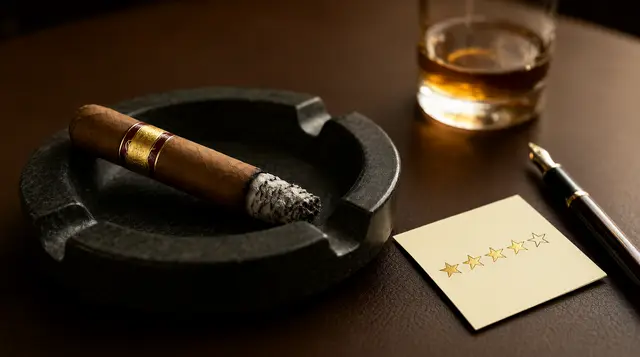
To rate a cigar, score three things separately and then combine them: how well it was built and burned, how it tasted, and how much you enjoyed it. Take a note at each third while you smoke instead of summing up at the end, use the same scale every time, and finish with one plain question, which is whether you would buy it again.
That is the whole method. The rest of this page is detail: what to look for in each of the three, when in the smoke to judge it, a score sheet you can copy onto paper, and how the scales you see in magazines line up against a simple five-star rating.
You do not need a trained palate for any of it. A rating is a note to your future self about a cigar, and the only person it has to make sense to is you.
The three things to judge
Most rating systems, however many boxes they have, come down to the same three questions. Scoring them separately matters because a cigar can be excellent at one and poor at another, and a single number hides that.
Construction and burn. This is the mechanical part and the easiest to judge honestly. Was the wrapper intact and the cigar evenly filled, with no soft spots? Was the draw easy, too loose, or tight like a clogged straw? Did it burn in a straight line or need touching up with the lighter? Did the ash hold, and did the cigar stay lit when you set it down for a minute?
Aroma and flavor. This is what it tasted and smelled like. Was it pleasant? Was there more than one thing going on, and did it change as it burned or stay the same from start to finish? Did anything turn harsh or bitter? You do not need the vocabulary. Sweet, earthy, peppery, and like coffee are all perfectly good notes.
Overall enjoyment. This is the gut score, and it is allowed to disagree with the other two. A cheap cigar with a wavy burn that you loved on a good evening deserves a high enjoyment score. A flawless, expensive one that bored you does not.
Keep strength out of the score. How hard a cigar hits is a description, like its size, and a strong cigar is neither better nor worse than a mild one. Write it down next to the rating instead.
| Category | What you are judging | Signs of a high score | Signs of a low score |
|---|---|---|---|
| Construction and burn | How it was built and how it behaved | Easy draw, even burn line, ash that holds, stays lit | Tight or loose draw, canoeing, repeated relights, wrapper cracking |
| Aroma and flavor | How it smelled and tasted | Pleasant, layered, changes across the thirds, clean finish | Flat, harsh, bitter, a chemical or sour note |
| Overall enjoyment | Whether it was a good hour | You were sorry when it ended | You put it down early or kept checking how much was left |
How to rate a cigar, step by step
Step one is before you light it. Look at the wrapper, give the cigar a gentle squeeze along its length, cut it, and take a draw unlit. This cold draw tells you about the construction and gives a first hint of flavor. Jot one line.
Step two is the first third. Give it a few minutes to settle after lighting, since the first puffs are not representative. Then note the draw, the burn, and what you taste.
Step three is the middle third. This is usually where a cigar shows its main character. Note what changed from the first third, if anything.
Step four is the final third. Flavor and strength often build here. Note whether it stayed enjoyable or turned hot and bitter, and where you put it down.
Step five is the score. Give each of the three categories a number while the cigar is still fresh in your mind, then answer the smoke-again question with a yes or a no.
The reason for notes at each third is memory. By the end of an hour you will have forgotten how the cigar opened, and the last ten minutes will color your whole impression. Three short notes fix that.
A few conditions make your ratings more consistent. Smoke on a full stomach, not right after strong food or a peaty whisky, and slowly, about a puff a minute, because a cigar that is smoked too fast turns bitter and you end up marking the cigar down for your own pace.
Which rating scale to use
Use the smallest scale you can apply consistently. That is the entire rule, and for most people it means five stars with half points.
The 100-point scale is the one magazines use, and it looks precise. In practice nearly every published score falls between 85 and 95, so it is really a ten-point scale wearing a bigger number. Cigar Aficionado publishes its bands: 95 to 100 is classic, 90 to 94 is outstanding, 80 to 89 is very good to excellent, 70 to 79 is average to good commercial quality, and below 70 is not recommended. If you are one person rating cigars for yourself, deciding whether something is an 88 or an 89 is false precision.
A 10-point scale is a good middle ground and easy to think in.
Five stars with half points gives you ten usable levels, which is as fine as most palates can honestly distinguish. It is the scale Cigarista uses: each of the three categories gets 0 to 5 in half steps, and the app averages them.
Whichever you choose, write down what the numbers mean to you once, and stick to it. The table below is a rough translation between scales so you can read other people's scores. It is a guide to how the scales are commonly used, not an official conversion.
| What it means | 5-star | 10-point | 100-point |
|---|---|---|---|
| One of the best you have smoked | 5 | 10 | 95 and up |
| Excellent, buy a box | 4.5 | 9 | 92 to 94 |
| Very good, would buy again | 4 | 8 | 89 to 91 |
| Good, nothing wrong with it | 3.5 | 7 | 86 to 88 |
| Fine, would not seek it out | 3 | 6 | 82 to 85 |
| Flawed | 2 to 2.5 | 4 to 5 | 75 to 81 |
| Would not finish another | 1.5 and below | 3 and below | Below 75 |
What is a good cigar rating?
On the 100-point scale magazines use, 90 or above is considered outstanding and anything in the high 80s is a very good cigar. On a five-star scale, 4 stars or more is the equivalent. Published scores cluster near the top because poor cigars rarely get reviewed, so an 87 is not a bad score.
What does a 90-rated cigar mean?
It means the reviewer considered it outstanding. In Cigar Aficionado's published scale, 90 to 94 is outstanding and 95 to 100 is classic. A score is one reviewer's opinion on one day, and different publications are not calibrated to each other, so treat it as a recommendation, not a measurement.
A score sheet you can copy
Here is a one-page sheet. Rule it into a notebook or copy it into a note on your phone. It takes about a minute to fill in.
If you want a fuller version with every field worth recording, including price and where you bought it, the cigar journal template linked at the bottom of this page has it.
| Field | What to write |
|---|---|
| Cigar | Brand, line, and size |
| Date | When you smoked it |
| Cold draw | One line before lighting |
| First third | Draw, burn, and what you taste |
| Middle third | What changed |
| Final third | How it finished, and where you put it down |
| Strength | Mild, medium, or full (not part of the score) |
| Construction and burn | 0 to 5 |
| Aroma and flavor | 0 to 5 |
| Overall enjoyment | 0 to 5 |
| Overall | The average of the three |
| Smoke again? | Yes or no |
Mistakes that make ratings useless
Rating the band. If you know a cigar cost thirty dollars or won an award, you will taste what you expect to. You cannot fully switch that off, but you can notice it. The smoke-again question helps, because it is about your money.
Rating one cigar once. Cigars vary from stick to stick, and the same cigar smokes differently after six months in the humidor. One bad sample can be a bad sample. If a cigar surprised you either way, rate it again before you decide. This is the weakness of a paper journal with one line per cigar, and it is why the app keeps a separate entry for every smoke.
Letting the setting do the scoring. A cigar on a beach with friends will always beat the same cigar smoked alone in a cold garage. Note the occasion, and take the enjoyment score with that in mind.
Drifting. If your fours slowly become threes over a year because your taste got pickier, old and new ratings stop being comparable. Reread what your numbers mean every so often.
Rating a cigar that was stored badly. A dried-out or over-humidified cigar burns poorly and tastes harsh, and that is the storage talking. If the cigar felt crunchy or spongy, note it and do not hold the result against the blend.
Common questions
How do you rate a cigar for beginners?
Score three things from 0 to 5: how well it was built and burned, how it tasted, and how much you enjoyed it. Average them, then write down whether you would smoke it again. You do not need tasting vocabulary. Plain words like sweet, peppery, or harsh are enough, and the smoke-again answer is the part you will use most.
What do cigar reviewers look for?
Broadly the same things in every system: appearance and construction, how the cigar draws and burns, the flavor and how it develops over the smoke, and an overall impression. Professional panels usually smoke cigars blind, with the bands removed, so the name and price cannot influence the score.
Is a 5-star or 100-point scale better for rating cigars?
For personal use, five stars with half points. It gives ten levels, which is about as fine as most people can tell apart consistently. The 100-point scale suits publications comparing thousands of cigars, but in practice almost all published scores sit between 85 and 95, so it offers less precision than it appears to.
Should strength affect a cigar's rating?
No. Strength is a characteristic, like size or wrapper color. A full-strength cigar is not better than a mild one, only different, and which you prefer is personal. Record strength next to the rating so you can spot your own preference over time.
How many cigars should I smoke before rating one?
You can rate after one, and you should, because one honest note beats none. Treat it as provisional. Cigars vary between sticks and change with age, so if a cigar was unusually good or bad, smoke a second before you settle on a verdict.
Is there an app for rating cigars?
Yes, several. Cigarista uses the three-category method described here: you rate construction and burn, aroma and flavor, and overall enjoyment from 0 to 5, tap the traits that apply, and mark whether you would smoke it again. Each smoke of the same cigar is saved as its own entry, and rating is free.
Explore the catalog
Start browsing the catalog
Every line, its specs and sizes, and what members have logged.
Keep reading
More guides like this


Rate your next cigar in under a minute.
Cigarista uses this same three-part score: construction and burn, aroma and flavor, and overall enjoyment, with traits you tap and a smoke-again verdict. Rating and reviewing are free.