Guide · Reference
Cigar Terms: A Plain-English Glossary of 90 Words, From Nubbing to Ligero

Cigar terms are the vocabulary for how a cigar is built, what tobacco goes into it, what shape it takes, how it burns, how you store it, and how smokers talk to each other about all of it. The list you need on day one is short: wrapper, binder, filler, cap, foot, vitola, ring gauge, draw, and humidor, and everything else you can pick up one cigar at a time.
Most cigar glossaries are a long alphabetical wall of factory jargon written decades ago. They will tell you what a bofeton is, but not what a tupperdor, a coolidor, or a nubber is, and they skip the slang you actually run into in a lounge or a forum thread. This one is grouped by what you are doing when the word comes up: looking at the cigar, reading the box, picking a size, lighting and smoking, storing, talking to other smokers, and buying.
Every definition stands on its own, so jump straight to the section you need. Where a term deserves more than a paragraph, I point you to the guide that covers it in full.
How I picked these
I built the term list from the definitional questions people actually type into search, including the autocomplete suggestions around nubbing, herf, plume, and storage, then compared it against the established glossaries to see what they cover and what they leave out. Anything contested, like the origin of herf, the plume debate, or the Habanos release program dates, I checked against more than one source. Where the hobby genuinely disagrees, the definition says so instead of picking a side.
Cigar anatomy and construction terms
Start here. These are the words for the physical cigar in your hand, plus the people and techniques that put it together. If you only learn one section, make it this one, because every review, shop conversation, and how-to assumes you know it.
The basic structure is three layers. Filler in the core, a binder leaf holding the filler together, and a wrapper leaf on the outside. Everything else in this section is either a part of that structure or a way of finishing it.
What is a wrapper in cigars?
The wrapper is the single outer leaf rolled around the outside of a cigar. It is the leaf you see and your lips touch, chosen for looks, texture, and a big share of the aroma, and growers treat it more carefully than any other leaf. The wrapper types guide covers the colors and origins.
What is a binder in cigars?
The binder is the middle leaf that wraps the filler and holds the bunch together before the wrapper goes on. It is usually a tougher, less attractive leaf picked for strength and an even burn. Nobody shops by binder, but a poor one shows up as a cigar that burns crooked.
What is filler in a cigar?
Filler is the blend of leaves bunched in the core of a cigar, and it is most of the tobacco by weight. That makes it the biggest driver of body and strength. Blenders typically mix leaves from different parts of the plant, and often different countries, to build the flavor.
What is the difference between long filler and short filler?
Long filler means whole leaves running the full length of the cigar, the standard for premium handmade cigars. Short filler is chopped scraps, common in machine-made and budget cigars, and it tends to burn hotter and faster. Mixed filler, sometimes called a Cuban sandwich, tucks short filler inside long-filler leaves.
What is the cap of a cigar?
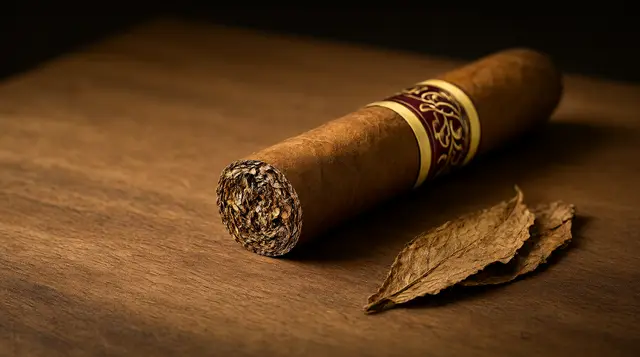
The cap is a small round piece of wrapper leaf glued over the head, the closed end you put in your mouth. It seals the cigar and keeps the wrapper from unraveling, and it is the part you cut. Take a sliver of it, never past the shoulder, and the cigar holds together.
What is a triple cap on a cigar?
A triple cap is three small layered pieces of wrapper leaf built up on the head instead of one. It is a hallmark of Cuban rolling and shows up on plenty of premium non-Cuban cigars too. It looks tidy, gives you a little margin when you cut, and signals a roller who took their time.
What is a pigtail on a cigar?
A pigtail is a little twisted curl of wrapper leaf left at the head instead of a flat, finished cap. It is mostly decorative, a finishing flourish some brands use as a signature. You do not smoke it: snip it off with your normal cut and carry on.
What is the shoulder of a cigar?
The shoulder is where the rounded head of a cigar curves into the straight body. It is the line not to cut past. Cut above it and the cap holds the wrapper in place; cut below it and the wrapper has nothing anchoring it, so it starts to peel and unravel while you smoke.
What is the foot of a cigar?
The foot is the open end of a cigar that you light, where the filler, binder, and wrapper are all exposed. On most cigars it is cut clean and flat. It is the opposite end from the head and cap, and when people say toast the foot, this is the end they mean.
What is a shaggy foot cigar?
A shaggy foot is a foot left unfinished, with the filler leaves sticking out past the wrapper like a frayed edge. The first few puffs are filler only, so you taste the core of the blend before the wrapper joins in. It lights easily, but handle it gently, because loose leaf sheds.
What is a cigar band?
The band is the paper ring near the head of a cigar that carries the brand and often the line name. It is identification and decoration, nothing structural. Leave it on, or slide it off once the cigar warms and the glue loosens. If a band has you stumped, Cigarista can identify the cigar from a photo of it.
What is a secondary band on a cigar?
A secondary band is a second paper ring, usually just below the main band, that names the specific line, edition, or year. Cuban limited releases, for example, carry an Edición Limitada band under the brand band. Some makers put a band on the foot instead, which you remove before lighting.
What does box pressed mean for a cigar?
A box-pressed cigar has a squared-off profile instead of a round one. It is made either by packing cigars tightly into a box so they press against each other, or by putting them in a press before boxing. Fans like how it sits in the hand and mouth. Whether it burns differently is argued endlessly.
What is a barber pole cigar?
A barber pole cigar is wrapped in two different-colored wrapper leaves spiraled around each other, so it looks like a striped barber's pole. It is usually one light wrapper and one dark, such as a Connecticut and a maduro. It is a showpiece, and it lets you taste two wrappers in one cigar.
What is a torcedor?
A torcedor is a cigar roller, the skilled worker who applies the wrapper and finishes the cap by hand. The word comes from the Spanish torcer, to twist. In many factories the work is split: a buncher, or bonchero, assembles filler and binder, and the torcedor finishes the cigar.
What is entubado rolling?
Entubado is a bunching method where each filler leaf is rolled into its own little tube or scroll before the scrolls are bunched together. It is slow and demanding, so relatively few factories use it, but the open channels between the scrolls are prized for an easy draw and an even burn.
Tobacco leaf terms: ligero, seco, volado, and wrapper words
A tobacco plant does not give you one kind of leaf. Where a leaf grows on the stalk changes how thick it is, how strong it is, and how it burns, and blenders mix those leaves on purpose. These are the words you see in blend descriptions and on boxes.
The wrapper has its own vocabulary on top of that, mostly about color and how the leaf was grown and processed. One thing worth saying early: wrapper color tells you about the wrapper, not the strength of the whole cigar. A dark wrapper on a mild filler blend is still a mild cigar.
| Leaf | Where on the plant | Character | Job in the blend |
|---|---|---|---|
| Volado | Bottom | Thin, light, mild | Combustion: helps the cigar stay lit and burn evenly |
| Seco | Middle | Medium thickness, aromatic | Aroma and the main body of the flavor |
| Ligero | Top | Thick, oily, strongest, slow-burning | Strength and depth, usually placed in the center of the bunch |
| Medio tiempo | Very top, only on some plants | Scarce and the strongest leaf on the plant | Specialty blends; historically graded in with ligero |
What is ligero in cigars?
Ligero is the leaf from the top of the tobacco plant, where it gets the most sun. It is thick, oily, the strongest leaf on the plant, and slow to burn. Blenders use it for strength and depth, usually tucked in the center of the filler bunch. Full-strength cigars lean on plenty of it.
What is seco in cigars?
Seco is the leaf from the middle of the tobacco plant. It is thinner and milder than ligero and carries much of the aroma and flavor in a blend. Think of it as the main body of the filler, the part that gives a cigar its character without the punch.
What is volado in cigars?
Volado is the leaf from the bottom of the tobacco plant. It is thin, light, and mild, with little flavor of its own, but it burns well, so blenders add it to help the cigar stay lit and burn evenly. It is the unglamorous combustion leaf that makes the rest of the blend work.
What is medio tiempo tobacco?
Medio tiempo is a pair of leaves that grow at the very top of some tobacco plants, above the ligero. Many plants never produce them, which makes the leaf scarce, and it is the strongest tobacco the plant gives. It is not a seed variety. Cuba's Behike line is the famous example of a blend built around it.
What does shade grown mean for cigars?
Shade grown means the tobacco grew under cloth tents that filter the sun. Shaded leaf comes out thinner, smoother, paler, and more elastic, which makes ideal wrapper; Connecticut Shade is the classic. Sun grown is the opposite: open sun produces a thicker, darker, oilier leaf with more flavor and usually more strength.
What is a candela wrapper?
Candela, also called double claro, is a green wrapper. The leaf is cured quickly with heat, which locks in the chlorophyll instead of letting it fade to brown. It tastes grassy and fresh, sometimes a little sweet. It was the standard American cigar color in the mid-twentieth century and is a niche today.
What does maduro mean in cigars?
Maduro, Spanish for ripe, is a dark brown wrapper that gets its color from longer, hotter fermentation, often of thicker leaf. It usually tastes sweeter, with notes like chocolate, coffee, and earth. It does not automatically mean a stronger cigar, because the filler sets strength. The maduro guide has picks.
What is an oscuro wrapper?
Oscuro is the darkest wrapper shade, nearly black, darker than maduro. The leaf is typically left on the plant longest and fermented longest. Expect dense, sweet, earthy flavors. Like maduro, the color tells you about the wrapper, not the strength of the whole cigar.
What is a Habano wrapper?
A Habano wrapper is grown from Cuban-seed tobacco outside Cuba, most often in Nicaragua or Ecuador. It tends toward a reddish-brown color and a spicy, peppery edge. Do not confuse it with a Habano on its own, which is the Cuban name for a Cuban cigar.
What does Cuban seed mean on a cigar?
Cuban seed means the tobacco descends from Cuban seed stock but was grown somewhere else, such as Nicaragua, the Dominican Republic, or Honduras. It describes genetics, not origin. A Cuban-seed cigar is not a Cuban cigar, and soil and climate shape the leaf at least as much as the seed does.
What is a toothy wrapper?
A toothy wrapper has tiny bumps across its surface, like goosebumps, generally described as pockets of oil in the leaf. Tooth is most associated with Cameroon wrapper. Fans see it as a sign of an oily, aromatic leaf, and toothy wrappers often leave little white specks in the ash.
What is a puro cigar?
A puro is a cigar whose wrapper, binder, and filler all come from the same country, as in a Nicaraguan puro. In Spanish, puro is simply an everyday word for a cigar, so in a Spanish-speaking shop it means nothing special. In English-language shops it signals a single-country blend.
What is fermentation in cigar tobacco?
Fermentation is the stage after curing where tobacco is stacked in large piles, called pilones, and heats up from its own moisture. Workers break down and rebuild the piles to control the temperature. It strips out ammonia and harshness and develops flavor, which is why rushed tobacco often smokes sharp.
Cigar shape and size terms
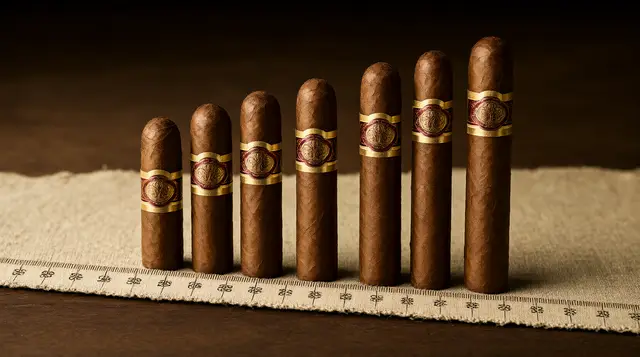
A cigar's size is two numbers and a name: length in inches, ring gauge for thickness, and a vitola name like Robusto or Churchill. The names are traditions, not standards, so the dimensions shift from brand to brand. Treat the numbers below as typical, not law.
All shapes fall into two families, straight-sided parejos and shaped figurados, and the sizes chart has a full table of dimensions and smoking times for each named vitola.
What does vitola mean?
Vitola is the trade term for a cigar's shape and size together. Robusto, Toro, and Churchill are all vitolas. Cuban factories add a distinction: the vitola de galera is the factory name for a format, and the vitola de salida is the name on the box. Same blend, different vitola, slightly different smoke.
What is ring gauge on a cigar?
Ring gauge is a cigar's diameter measured in 64ths of an inch. A 64 ring gauge is one inch across, and a 50 is 50/64 of an inch, about 19.8 millimeters. Bigger number, fatter cigar. Ring gauge changes the draw and how cool the smoke runs, not the strength.
What is a parejo cigar?
A parejo is a straight-sided cigar with a rounded head, the shape most cigars on a shop shelf take. Robustos, Toros, Coronas, and Churchills are all parejos. It is the counterpart to figurado, the family of tapered and irregular shapes.
What is a figurado cigar?
A figurado is any cigar that is not straight-sided: tapered heads, pointed feet, bulges in the middle. Torpedos, belicosos, and perfectos are all figurados. They take more skill to roll, and the taper changes how smoke concentrates as you draw, which is a big part of their appeal.
What is a corona cigar?
A corona is the classic medium-thin cigar, typically around 5.5 inches with a ring gauge in the low 40s, and long treated as the benchmark size. A petit corona is the shorter version. Because the wrapper is a bigger share of the tobacco in a thin cigar, coronas show off the wrapper well.
What is a robusto cigar?
A robusto is a short, thick cigar, typically about 5 inches long with a 50 ring gauge. It smokes in roughly 45 minutes to an hour, which makes it the default size in most lines and the one I hand a newer smoker who wants to taste a blend properly without committing a whole evening.
What is a toro cigar?
A toro is typically about 6 inches long with a ring gauge around 50 to 52. It is the robusto's longer sibling, good for an hour or more, and it has become one of the most common formats in non-Cuban lines. If a brand makes only a few sizes, a toro is usually one of them.
What is a Churchill cigar?
A Churchill is a long cigar, typically about 7 inches with a ring gauge around 47 to 48, named for Winston Churchill, who was famous for smoking long cigars. Expect 60 to 90 minutes. It is slim enough to keep the wrapper prominent and long enough for the flavor to develop.
What is a gordo cigar?
Gordo, Spanish for fat, describes cigars with a ring gauge of 60 or more, usually around 6 inches long. They burn cool and take a long time to finish, but the wrapper becomes a small share of the tobacco, so the blend can taste flatter than in a thinner size. Bigger is not the same as better.
What is a lancero cigar?
A lancero is a long, thin cigar, typically around 7 to 7.5 inches with a ring gauge near 38 to 40. The wrapper makes up a large share of the tobacco, so lanceros taste intensely of the wrapper. They are hard to roll and easy to plug, which is exactly why connoisseurs treat a good one as a test of a factory.
What is the difference between a torpedo and a belicoso?
Both are figurados with a tapered head. A torpedo traditionally tapers to a sharper, longer point, while a belicoso has a shorter, more rounded taper. In practice brands use the names loosely, along with pyramid, so check the actual shape. Cut a tapered head a little at a time to tune the draw.
What is a perfecto cigar?
A perfecto tapers at both ends with a bulge in the middle, and usually has a closed, pointed foot. The narrow foot lights easily, and the flavor tends to build as the burn reaches the wider body. It is an old-school shape and one of the harder ones to roll well.
Lighting, smoking, and burn terms
This is the vocabulary of the actual smoke, from the cut to the last inch. Most of it describes something you will notice on your own within a few cigars. Having the word just makes it easier to fix, or to explain to the person next to you.
The how-to-smoke guide walks through the sequence start to finish, and the troubleshooting guide covers the burn problems in more detail than a definition can.
What is a straight cut on a cigar?
A straight cut, made with a guillotine cutter, slices the cap off cleanly across the head. It is the most common cut and works on nearly every shape. Take only a sliver of the cap so you stay above the shoulder. The cutting guide walks through the straight, punch, and V cuts.
What is a punch cut?
A punch cut bores a small round hole in the cap instead of removing it. It keeps the cap intact, so the wrapper is less likely to unravel and less loose tobacco ends up on your tongue. It concentrates the draw, which suits round heads, but not pointed heads or very thin cigars.
What is a V cut on a cigar?
A V cut, made with a wedge cutter, notches a V-shaped channel into the cap. It opens more surface area than a punch while leaving most of the cap in place. Done cleanly with a sharp cutter, it draws well; done with a dull one, it crushes the head.
What is a cold draw?
A cold draw is a puff on a cut cigar before you light it. It tells you whether the draw is open or plugged while you can still do something about it, and it previews the unlit flavors, often hay, raisin, spice, or cocoa. Do not judge the whole cigar by it.
What does toasting a cigar mean?
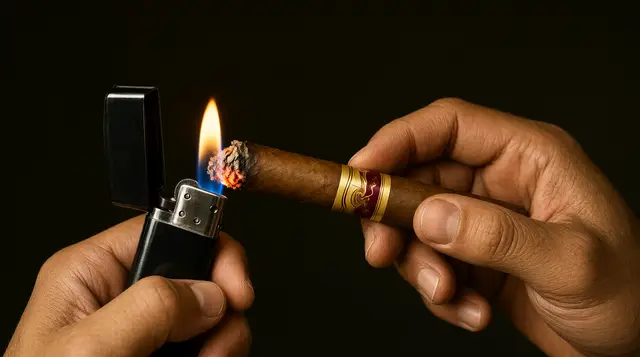
Toasting means warming the foot evenly with the flame held just below it, not touching, while you rotate the cigar. It gets the whole face of the foot ready to catch at once, which is the best insurance against a lopsided burn later. Then draw gently to finish the light.
What is a cedar spill?
A cedar spill is a thin strip of Spanish cedar, often torn from the sheet inside a cigar box, that you light and use as a taper. It gives a wide, gentle flame without butane or match-head flavor reaching the tobacco. It is ceremony as much as function, and it works.
What does draw mean in cigars?
Draw is how easily smoke pulls through a cigar when you puff. A loose draw gives lots of smoke with no effort and can burn hot; a tight draw makes you work for every puff. A good draw is in the middle: a gentle pull and a full mouth of smoke. It is the first thing to judge.
What is a plugged cigar?
A plugged cigar has a blockage in the filler that makes the draw tight or impossible, usually from a twisted or overpacked leaf. A draw tool pushed in from the head can open it, and gently rolling the cigar between your fingers sometimes helps. If neither works, it is a construction flaw, not your fault.
What does retrohale mean?
To retrohale is to push a little smoke gently out through your nose instead of only your mouth. Smell does most of the work of tasting, so a retrohale reveals spice and sweetness the tongue misses. Start with a tiny amount, since pepper stings. It is not inhaling; cigar smoke stays out of the lungs.
What does purging a cigar mean?
Purging means blowing gently back through the cigar from the head, so stale smoke exits through the foot. It clears built-up, bitter smoke after the cigar has sat for a while and can cool one that is running hot. Keep it to a soft, short exhale, and the next puff usually tastes cleaner.
What makes a good cigar ash?
A good ash is firm, holds together for an inch or so, and does not flake all over your shirt. A tight, solid ash usually points to well-bunched long-filler tobacco. Tap it off before it falls rather than flicking constantly. Do not read much into ash color; it is a weak quality signal.
What is canoeing in cigars?
Canoeing is when one side of a cigar burns faster than the other, so the burn line slants like the prow of a canoe. A lopsided light, puffing too hard, or a cigar stored too wet are the usual causes. The fix is a touch-up: a brief flame on the lagging side until it catches up.
What is tunneling in cigars?
Tunneling is when the core of a cigar burns ahead of the wrapper and binder, hollowing out the center while the outside lags or goes out. It is usually a too-moist cigar or one left too long between puffs. Touch up the outer rim with a flame so the wrapper catches up. The troubleshooting guide has more.
What are the thirds of a cigar?
Smokers split a cigar into first, second, and final thirds because the flavor usually shifts as it burns, and the final third typically runs stronger as the smoke passes through less tobacco. Reviews often describe each third separately. Noting each third in a journal, Cigarista's or a notebook, is the fastest way to learn what you like.
Cigar storage and humidity terms
A cigar is dried, fermented leaf that wants to stay at a steady humidity, and the hobby has built a whole vocabulary for keeping it there, much of it homemade. The short version: steady humidity somewhere in the 60s, temperature below the low 70s Fahrenheit, and no big swings.
Notice how many of these terms are hacks: tupperdors, coolidors, wineadors. That is not an accident. The expensive wooden box is the least important part of storing cigars well, and the storage guide explains why.
What is a humidor?
A humidor is any container that holds cigars at a steady humidity, traditionally a Spanish-cedar-lined wooden box with a tight lid. It can be a desktop box, a glass-front cabinet, or a walk-in room. The point is not the wood or the price; it is steady humidity, and plenty of airtight plastic boxes do that better.
What does RH mean for cigars?
RH is relative humidity, how much moisture the air holds compared with the most it could hold at that temperature. Cigars are usually kept around 62 to 70 percent RH. The old rule was 70/70, meaning 70 percent at 70 degrees Fahrenheit; many smokers now keep a little drier for a better burn. The cigar humidity guide goes deeper.
What is a hygrometer?
A hygrometer measures the humidity inside your humidor. Cheap analog dials are often off by several points, so most people use a digital one and check it with a calibration kit or the salt test, which uses damp salt in a sealed bag to create a known reading of about 75 percent. Trust a calibrated hygrometer, not a guess.
What is a two-way humidity pack?
A two-way humidity pack is a sealed pouch of salt solution that releases or absorbs moisture to hold a set humidity, such as 65 or 69 percent. Boveda is the best-known brand. You drop one in with your cigars and replace it when it turns stiff. Packs made good storage close to foolproof.
What does seasoning a humidor mean?
Seasoning is bringing the bare Spanish cedar in a new humidor up to humidity before any cigars go in. Dry wood pulls moisture out of whatever sits inside it, cigars included. You add moisture, usually with humidity packs, and wait until the hygrometer holds steady for a few days. The humidor seasoning guide has the steps.
What is Spanish cedar?
Spanish cedar is the wood used to line humidors and cigar boxes. Despite the name, it is not a true cedar but a tropical hardwood in the mahogany family. It holds and releases moisture well and gives off a subtle aroma that cigars pick up over time.
What is a tupperdor?
A tupperdor is an airtight plastic food container, the name is a riff on Tupperware, used as a humidor with a humidity pack inside. It often seals better than a wooden humidor, costs a few dollars, and holds humidity steadily. It is the honest answer for most people's first real cigar storage.
What is a coolidor?
A coolidor is a picnic cooler converted into a humidor: cigars inside, often still in their boxes, with humidity packs or beads to hold the RH. Coolers are built to seal and insulate, so they hold humidity and temperature steadily. It is the classic budget move once a collection outgrows a desktop box.
What is a wineador?
A wineador is a thermoelectric wine cooler converted to cigar storage, with shelves or drawers and humidity packs added. Its real advantage is temperature control in a hot room, which keeps tobacco beetles from hatching. It does not manage humidity on its own, so you still need packs or beads inside.
What is a dry box for cigars?
A dry box is an unhumidified container, often just an empty wooden cigar box, where a cigar sits for a few hours to a day or two before smoking. Dry boxing takes the edge off excess moisture so a damp cigar burns and draws better. Leave it out too long and it simply dries out.
What does resting cigars mean?
Resting means letting newly arrived cigars sit in your humidor before smoking them, so they recover from shipping and settle at your humidity. Many smokers wait at least a week or two. Smoke one straight out of the package and it may burn badly or taste flat, which is not really the cigar's fault.
What is cigar plume or bloom?
Plume, also called bloom, is supposed to be a fine white crystal dust of the cigar's own oils and a sign of good aging. The one lab test of collector samples found every sample was mold. My working rule: treat white growth as mold until proven otherwise. The plume vs mold guide explains how to look.
What is a tobacco beetle?
The tobacco beetle (Lasioderma serricorne) is a tiny insect whose larvae bore through cigars, leaving perfectly round pinholes and fine tobacco dust. Eggs can sit in the leaf unnoticed and hatch when storage climbs above roughly 72 to 75 degrees Fahrenheit. The fix is a staged freeze, covered in the freezing guide.
Cigar slang: herf, nubbing, ROTT, and the rest
Cigar smokers have their own dialect, a lot of it born on 1990s newsgroups and forums, and almost none of it appears in the traditional glossaries. This is the section I wish had existed when I started reading cigar threads and had no idea why everyone was bombing each other.
The abbreviations come up constantly, so they get a table first.
| Abbreviation | Stands for | What it means |
|---|---|---|
| BOTL / SOTL | Brother / Sister of the Leaf | A fellow cigar smoker |
| ROTT | Right off the truck | A cigar smoked as soon as it arrives, without resting |
| CC / NC | Cuban cigar / non-Cuban | Shorthand for origin |
| B&M | Brick and mortar | A physical cigar shop |
| EL / ER | Edición Limitada / Edición Regional | Habanos annual limited and regional releases |
| LCDH | La Casa del Habano | An official Habanos franchise shop |
| TAA | Tobacconists' Association of America | Retailer group with yearly exclusive cigars |
| RH | Relative humidity | The humidity number your hygrometer shows |
| vHerf | Virtual herf | A cigar get-together over video chat |
What does stick mean in cigars?
Stick is the most common casual word for a single cigar, as in which stick are you smoking tonight. It is neutral, not a judgment of quality. You will also hear smoke, gar, and stogie used the same way, and nobody in a lounge will blink at any of them.
What is a stogie?
A stogie is slang for a cigar, usually a casual or inexpensive one. The usual story traces the word to Conestoga, Pennsylvania, where long, cheap cigars were associated with the drivers of Conestoga wagons in the 1800s. Today people use it for any cigar, usually affectionately.
What is a herf in cigars?
A herf is a gathering of people smoking cigars together, anything from a backyard hang to an organized event. It works as a verb too: to herf is to smoke. The word's exact origin is murky, but it spread through cigar newsgroups like alt.smokers.cigars in the 1990s. A vHerf is the same thing over video.
What is a nub in cigars?
The nub is the last short stub of a cigar, and nubbing means smoking it down that far, until the heat nears your fingers. A cigar that stays pleasant right to the end gets called nub-worthy, which is real praise. Not to be confused with Nub, a line of short, thick cigars from Oliva.
What is a cigar nubber?
A nubber is a small tool for holding the last inch or two of a cigar, so you can smoke it down without burning your fingers. Most are a pin or spike on a handle or base that skewers the head. Plenty of smokers use a toothpick or a straightened paper clip instead, though the nub can spin on a thin wire.
What does ROTT mean in cigars?
ROTT stands for right off the truck: a cigar smoked as soon as it arrives in the mail, without resting in a humidor first. It usually comes up as a caveat in a review, since cigars smoked ROTT can burn unevenly or taste flatter than they will after a week or two of rest.
What is a cigar bomb?
A cigar bomb is a surprise package of cigars sent to another smoker, usually a friend from a forum or club, without warning. Bombing someone is a gesture of generosity, and getting bombed tends to start a friendly back-and-forth of return packages. It is one of the nicer traditions in the hobby.
What does BOTL mean?
BOTL stands for Brother of the Leaf, and SOTL for Sister of the Leaf. Both mean a fellow cigar smoker, and you will see them as greetings and sign-offs on forums and in lounges. They signal fellowship, not any formal membership, and anyone who smokes cigars qualifies.
What do CC and NC mean in cigars?
CC means Cuban cigar and NC means non-Cuban, which covers anything from Nicaragua, the Dominican Republic, Honduras, and elsewhere. The split matters most in the US, where buying Cuban cigars is restricted, so forums often divide their discussions along CC and NC lines. The Cuban legality guide has the details.
What is a lector in a cigar factory?
A lector is a reader who reads aloud to the rollers in Cuban cigar factories, from newspapers to novels, while they work. The tradition goes back to the 1860s and continues today. Montecristo is said to take its name from The Count of Monte Cristo, a favorite with the rollers.
What is a slow-smoking competition?
A slow-smoking competition is a contest to make one cigar last as long as possible. Everyone smokes the same cigar, lights it once within a time limit, and cannot relight; whoever keeps it burning longest wins. The Cigar Smoking World Championship is the best-known. It rewards gentle, patient puffing.
Cigar buying and release terms
Last, the words on shop shelves, release announcements, and price tags. This is where real information and marketing blur together, so I have said which terms actually tell you something and which just sound good.
A useful rule across the whole section: words like limited, boutique, and small batch describe scarcity or scale. None of them is a promise about how the cigar tastes.
What does B&M mean in cigars?
B&M stands for brick and mortar, a physical cigar shop as opposed to an online retailer. Smokers use it constantly, as in supporting your local B&M. A good one lets you see, feel, and smell a cigar before buying, and keeps its walk-in humidor at a steady humidity.
What is a boutique cigar?
A boutique cigar comes from a small producer making limited quantities, as opposed to the big companies with global distribution. The term has no legal or industry definition, so it describes scale and attitude more than quality. Some boutique brands are excellent; some just have nice bands.
What does limited edition mean on a cigar?
Limited edition means the maker plans to produce a set quantity or for a set period. There is no standard for how limited, so it can mean a few hundred boxes or a large annual run. Small batch works the same way. It tells you the cigar may be hard to find later, not that it is better.
What is an Edición Limitada cigar?
Edición Limitada is Habanos S.A.'s annual series of limited-release Cuban cigars, launched in 2000 and recognizable by a black-and-gold secondary band, with the year printed on it from 2001 on. Releases usually come in sizes the brand does not normally make. Collectors chase them, and many get set aside to age.
What is a Regional Edition cigar?
A Regional Edition, or Edición Regional, is a Cuban cigar made for a specific country or market, commissioned by that market's Habanos distributor. The program started in 2005. The secondary band names the region, and the cigar is meant to be sold there, which is why collectors elsewhere hunt for them.
What is a TAA exclusive cigar?
A TAA exclusive is a cigar made only for retail members of the Tobacconists' Association of America, a trade group founded in 1968. Each year a range of manufacturers release one, sold only through member shops, with part of the proceeds going to the association. If you see TAA on a band, that is what it means.
What is a bundle of cigars?
A bundle is a pack of cigars, often 20 or 25, sold wrapped in cellophane or plastic instead of a finished box. Skipping the box cuts cost, so bundles are usually the cheapest way to buy at a given quality level. Plenty are solid everyday smokes, and they are where a lot of good yard cigars come from.
What is a cigar box code?
A box code is the stamp on the bottom of a Cuban cigar box showing the factory and the month and year it was packed. Collectors use it to know how much age a box has and as one check of authenticity, though counterfeiters copy codes too. The fake Cuban guide covers what else to check.
What is a cigar tubo?
A tubo is a cigar sealed in its own tube, usually aluminum or glass, often with a thin cedar lining. It protects the cigar in a pocket or a bag and keeps it in decent shape for a while outside a humidor. It is not airtight forever, so tubos still belong in humidity for long-term storage.
What is cello on a cigar?
Cello is the clear cellophane sleeve many cigars come in. It protects the wrapper from handling and shipping damage and lets humidity pass through slowly, so cigars in cello can go straight into a humidor. Whether to remove it for storage is personal preference; either way works.
What is La Casa del Habano?
La Casa del Habano is the official franchise chain of Cuban cigar shops licensed by Habanos S.A., with locations in many countries. They stock Cuban cigars, sometimes including shop-exclusive releases, and are a reliable source of authentic stock where Cuban cigars are legal. On forums it is shortened to LCDH.
Common questions
What is cigar slang for a cigar?
The everyday words are stick, smoke, gar, and stogie, all neutral ways to say cigar. A yard gar is a cheap cigar you smoke while doing yard work or anything else where it will not get your full attention. A box-worthy cigar is one good enough that you would buy a whole box rather than a single.
What do cigar smokers call each other?
On forums and in lounges, the classic term is BOTL, Brother of the Leaf, or SOTL, Sister of the Leaf. Aficionado is the more formal word for a serious cigar enthusiast. In person, most people just say they smoke cigars, and that is perfectly fine.
What does nubbing a cigar mean?
Nubbing a cigar means smoking it all the way down to a short stub, the nub, usually until the heat reaches your fingers. It is a compliment to the cigar, since most turn harsh in the last inch or two. There is no rule that you must; putting a cigar down when it stops tasting good is completely normal.
Why are so many cigar terms in Spanish?
Because the premium cigar trade grew up in Cuba and the Spanish-speaking Caribbean and Central America, and most premium cigars are still made in Nicaragua, the Dominican Republic, Honduras, and Cuba. Growers, rollers, and blenders named things in Spanish, and the words stuck in English: vitola, ligero, torcedor, puro.
How do you pronounce common cigar terms?
Roughly: vitola is vee-TOE-lah, ligero is lee-HAIR-oh, seco is SEH-ko, volado is vo-LAH-doh, torcedor is tor-seh-DOOR, Habano is ah-BAH-no, Corojo is ko-ROH-ho, and pilón is pee-LOHN. Nobody in a lounge will judge an anglicized version. Just do not pronounce the H in Habano.
What cigar terms should a beginner learn first?
Ten words get you through any shop: wrapper, binder, filler, cap, foot, vitola, ring gauge, draw, body, and humidor. Add strength, which means the nicotine hit and is not the same as body, and you can follow any cigar review. The rest you pick up one cigar at a time.
Explore the catalog
Start browsing the catalog
Every line, its specs and sizes, and what members have logged.
Keep reading
More guides like this
Smoke one off this list? Log it.
Snap the band, Cigarista identifies it, and your rating joins the cigar’s page. New members get 2 free scans. No card required.